How to Pack Fragile Items for Moving and Storage
Packing fragile items properly is crucial to prevent damage during transit. Whether you’re preparing for long-term storage or learning how to pack for a move, using the right techniques will ensure your delicate belongings remain safe. Broken dishes, cracked screens, and shattered glass are among the most common moving-day casualties — and almost all of them are preventable with the right approach.
This guide covers everything from choosing the right boxes and packing materials to item-specific techniques for dishes, glassware, electronics, artwork, and more. Whether you’re handling a local move or a long-distance relocation, these packing strategies will help your fragile items arrive in the same condition they left.
Why Proper Packing Matters for Fragile Items
Fragile items face multiple risks during a move — vibration, pressure, shifting, impact, and stacking. Without proper protection, even a short drive across town can result in cracks, chips, or complete breakage. For interstate and cross-country moves, these risks multiply with extended transit times, multiple loading and unloading points, and road vibration over hundreds of miles.
Investing time in packing fragile items correctly saves you money on replacements, reduces stress on moving day, and protects items with sentimental value that can’t be replaced at any price. It’s also important to note that if you pack your own boxes, most moving companies — including Poseidon Moving — are not liable for damage to items inside them. That’s one more reason to pack fragile items right the first time, or to consider professional packing services for your most delicate belongings.
Essential Packing Materials for Fragile Items
Before you start wrapping anything, make sure you have the right supplies on hand. Using proper packing materials is the foundation of safe fragile-item packing.
● Sturdy, double-walled boxes — standard and dish boxes provide the structure fragile items need.
● Bubble wrap — ideal for wrapping individual items; provides shock absorption against impact.
● Packing paper — used for wrapping and cushioning without leaving ink marks (unlike newspaper).
● Dish dividers / cell kits — cardboard inserts that keep dishes and glassware separated inside boxes.
● Packing tape — reinforce the bottom of every box with an H-pattern for added strength.
● Foam pouches and corner protectors — for items with sharp edges, glass surfaces, or ornate details.
● Markers and “FRAGILE” labels — clearly mark every box so movers and helpers handle them with care.
Household hack: Soft items you’re already packing — T-shirts, towels, socks, and linens — make excellent free cushioning for dishes, mugs, and small electronics. Just make sure each fragile item is fully wrapped and padded before boxing.
General Rules for Packing Fragile Items
Regardless of what you’re packing, these principles apply to every fragile item:
✔ Wrap every item individually — never let two fragile items touch each other directly inside a box.
✔ Reinforce box bottoms — tape across the bottom in an H-pattern and add a layer of crumpled paper before placing items inside.
✔ Heavier items on the bottom, lighter on top — prevents crushing inside the box and during stacking.
✔ Fill every gap — use crumpled packing paper, foam peanuts, or soft items to eliminate movement inside the box.
✔ Don’t overpack boxes — keep each box under 50 lbs. Overpacked boxes are more likely to break and harder to carry safely.
✔ Label clearly — write “FRAGILE” and “THIS SIDE UP” on all sides. Include the room name and a brief list of contents.
✔ Double-box for long distance — for extremely delicate items, pack in one box, then place that box inside a larger box with cushioning between them.
How to Pack Dishes, Glassware, and Kitchen Items
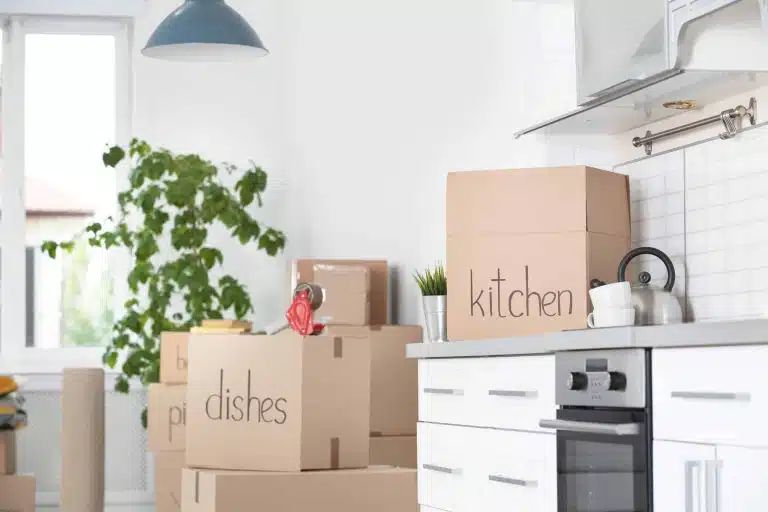
The kitchen is typically the trickiest room to pack because so many items are fragile — plates, bowls, wine glasses, mugs, and serving dishes all need individual attention.
Plates and Bowls
Wrap each plate or bowl individually in packing paper or bubble wrap. Stack plates vertically (on their edges, like records in a box) rather than flat — vertical positioning distributes pressure more evenly and significantly reduces breakage risk. Use a dish box with cell dividers when possible, and fill any remaining gaps with crumpled paper.
Glasses, Wine Glasses, and Mugs
Stuff the inside of each glass or mug with crumpled packing paper first, then wrap the outside in 2–3 layers of bubble wrap or packing paper. Place glasses upright in a dish box with cell dividers. Wine glasses and stemware are especially vulnerable — wrap the stem separately and use extra padding around the base.
Pots, Pans, and Small Appliances
Stack pots and pans with packing paper between each piece to prevent scratching. Small appliances like blenders, coffee makers, and toasters should be wrapped in bubble wrap and placed in snug-fitting boxes. If you still have the original packaging, use it — it was designed for that exact item.
Knives and Sharp Items
Wrap knife blades in several layers of packing paper or use blade guards. Bundle knives together with rubber bands (blades pointing the same direction) and wrap the entire bundle in a towel. Clearly label the box as containing sharp items.
How to Pack Electronics for Moving
Electronics are sensitive to impact, static, temperature changes, and moisture — all of which increase during a move. Proper packing protects both the device and any data stored on it.
✔ Use original boxes when possible — they were designed to fit and protect that exact item. If you don’t have them, use a snug box with plenty of bubble wrap padding on all sides.
✔ Back up all data — before disconnecting computers, hard drives, or gaming consoles, back up important files to the cloud or an external drive.
✔ Photograph cable setups — take pictures of the back of your TV, computer, or stereo before unplugging so reassembly is fast and frustration-free.
✔ Label and bag all cables — bundle cords with rubber bands or twist ties and place them in labeled zip-top bags.
✔ Wrap screens with care — for TVs and monitors, use a dedicated TV box with bubble wrap. Never lay a flat-screen face down — always transport upright.
✔ Remove batteries and ink cartridges — batteries can corrode during extended storage, and ink cartridges can leak. Remove them before packing.
How to Pack Artwork, Mirrors, and Picture Frames
Flat, fragile items like framed art, mirrors, and glass tabletops are among the most commonly damaged belongings during a move. They require specific handling to stay safe.
✔ Apply painter’s tape in an X-pattern across glass surfaces — if the glass breaks, the tape holds the shards in place and prevents further damage.
✔ Wrap the entire piece in bubble wrap, paying extra attention to corners and edges.
✔ Place in a properly sized picture/mirror box — available in Small (24x6x18), Medium (30x6x24), Large (56x10x36), and XL (67x8x43).
✔ Always transport upright, never flat — and cushion between soft items like mattresses or padded furniture in the truck.
✔ For high-value artwork or antique frames, consider custom crating for maximum protection during cross-country moves.
How to Pack Clothing for Moving and Storage
While most clothing isn’t fragile, certain fabrics and garments require special care — especially for long-term storage or cross-country moves where temperature and humidity can vary.
Everyday Clothing
For hanging clothes, wardrobe boxes are the fastest and easiest solution — transfer clothes directly from the closet to the box on the hanging bar. No folding, no wrinkles. For folded items, medium or large moving boxes work well. Use soft clothing like T-shirts and towels as cushioning for fragile items in other boxes to save space.
Wool and Cashmere
Wool and cashmere are susceptible to moths and moisture damage. Wrap these items in white acid-free tissue paper before placing them in airtight containers or vacuum bags. If storing in drawers, use cedar drawer liners or cedar balls to repel moths and keep garments fresh.
Fur and Leather
Fur and leather garments are more delicate and require breathable storage — never pack them in plastic, as trapped moisture can damage the pelt or cause mildew. Avoid mothballs (the scent is nearly impossible to remove) and cedar oils (which can damage leather). Clean and dry thoroughly before storing, and use breathable garment bags for transport.
How to Pack Collectibles, Antiques, and High-Value Items
Items with high monetary or sentimental value — antiques, fine china, figurines, musical instruments, and collectibles — require the most attention during a move.
✔ Wrap each item individually in acid-free packing paper, then in bubble wrap.
✔ Use custom crating for oversized or irreplaceable pieces — wood crates with foam inserts offer the highest level of protection.
✔ Photograph every item from multiple angles before wrapping — this serves as proof of condition for insurance claims.
✔ Declare high-value items on your moving inventory — if an item is worth over $100 per pound, it must be declared to qualify for full-value protection.
✔ Consider third-party moving insurance for items that valuation coverage alone wouldn’t adequately protect.
Packing Fragile Items for Long-Term Storage
If your fragile items are going into storage rather than directly to a new home, a few additional precautions will keep them safe over weeks or months.
✔ Use climate-controlled storage when possible — temperature and humidity fluctuations can warp wood, crack glass, and promote mold growth.
✔ Avoid newspaper for wrapping — ink can transfer to surfaces over time. Use clean packing paper or acid-free tissue instead.
✔ Elevate boxes off the floor — use pallets or shelving to protect against moisture and flooding.
✔ Don’t stack heavy boxes on top of fragile ones — label all fragile boxes clearly and place them on top of sturdier boxes.
✔ Create a storage inventory — list the contents of every box so you can find items without opening everything.
Should You Hire Professional Packing Services?
If packing fragile items feels overwhelming — or if you simply don’t have the time — professional packing is one of the smartest investments you can make during a move. At Poseidon Moving, our crew uses professional-grade materials and proven techniques to pack your most delicate belongings safely.
✔ Full and partial packing services available
✔ High-quality boxes, bubble wrap, packing paper, and specialty materials included
✔ Items packed by our crew are covered under your move’s valuation protection
✔ Over two decades of experience handling fragile, high-value, and specialty items
Important: Items you pack yourself are generally not covered by mover liability if damaged during transit. If you have high-value fragile items, professional packing gives you both better protection and better coverage. Request a free quote to add packing services to your move.