Moving to Boston: Relocation Guide 2026

Boston is one of the most expensive, most educated, and most historically significant cities in the country, and it makes very few compromises for newcomers. The streets are confusing, the winters are long, parking is a blood sport, and the rent on a one-bedroom apartment averages $3,417 per month. People move here anyway: for the hospitals, the universities, the biotech jobs, the harbor, and a city that is walkable in ways most American cities are not.
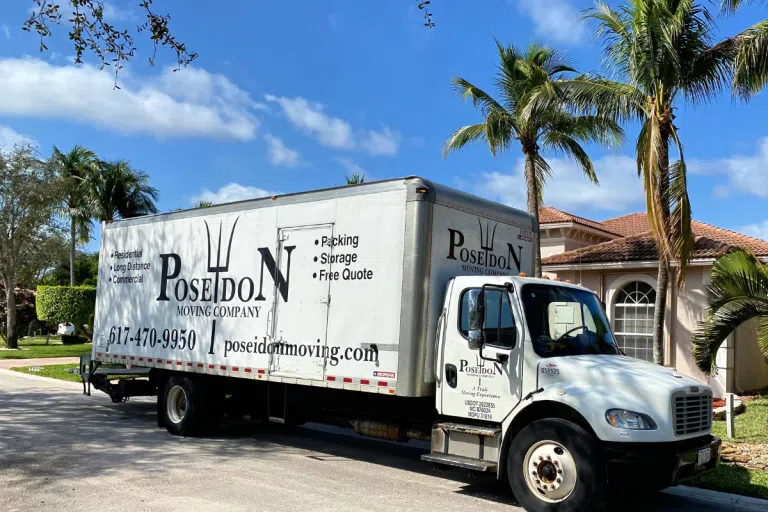
This guide covers what it actually costs to live in Boston in 2026, where the jobs are, which neighborhoods fit which lifestyles, and the Boston-specific logistics (September 1st, broker fees, parking permits) that catch every newcomer off guard. Boston is Poseidon Moving’s home city: our Boston movers have moved thousands of households into and around the metro and know every narrow street, triple-decker staircase, and building management office in it.
Pros of Moving to Boston
- World-class healthcare and biotech economy. Boston is the global epicenter of biotech and life sciences. Massachusetts General Hospital, Brigham and Women’s, Dana-Farber, and Boston Children’s are consistently ranked among the top hospitals nationally. The Kendall Square and Cambridge area is the densest biotech cluster on the planet: Moderna, Vertex, Novartis, Takeda, and hundreds of startups operate within walking distance of each other.
- Highest concentration of universities in the country. Harvard, MIT, Boston University, Boston College, Northeastern, Tufts, Berklee, Emerson, and dozens more are all within the metro area. This density creates a constant pipeline of talent, research, and cultural energy that defines the city’s identity.
- Walkable, transit-connected, and compact. Boston is one of the most walkable major cities in the U.S. The MBTA (the “T”) connects most of the metro by subway, bus, and commuter rail. You can live without a car here, especially in neighborhoods like Back Bay, Beacon Hill, Cambridge, and Somerville, which is rare for an American city.
- Four distinct seasons and coastal access. Fall in New England is unmatched. Summers are warm, with beach access to Cape Cod, the North Shore, and the Boston Harbor Islands. The city sits on the water, with a revitalized Seaport district and waterfront parks that did not exist 15 years ago.
- High median income and strong labor market. The Boston metro’s median household income exceeds $100,000, well above the national average. Total metro employment is about 2.8 million across healthcare, tech, finance, education, and professional services. The job market has been slow but stable, with employers holding onto workers even as hiring has cooled.
Cons of Moving to Boston
- Housing costs are among the highest in the nation. The median home sale price in Boston is $825,000 (January 2026). A one-bedroom apartment averages $3,417 per month. Inventory remains critically low: by 2025, only three municipalities in Greater Boston had median single-family prices below $500,000. The “starter home” has effectively disappeared from the market.
- Brutal, expensive winters. Boston gets an average of 49 inches of snow per year, with temperatures regularly below freezing from December through March. Heating costs run $150 to $300 or more per month depending on your apartment’s insulation and fuel type. Snow emergencies, parking bans, and icy sidewalks are facts of life from November through April.
- September 1st lease turnover chaos. The majority of Boston leases start on September 1st, creating the busiest and most expensive moving day in the city. Trucks are booked months in advance, streets are gridlocked with double-parked vans, and discarded furniture lines the sidewalks (locals call it “Allston Christmas”). If you can choose your lease start date, avoid September 1st entirely.
- Broker fees and upfront rental costs. Many Boston apartments require first month, last month, a security deposit, and a broker fee (typically one month’s rent), all due at signing. On a $3,000 per month apartment, that is $12,000 before you unpack a single box. Some landlords have moved to no-fee listings, but broker fees remain common.
- Aging infrastructure and traffic. The MBTA, while useful, is an aging system with frequent delays and service disruptions. Driving is complicated by confusing street layouts, limited parking, and aggressive drivers. The state income tax rate is a flat 5%, which adds to the overall cost burden alongside high property taxes and housing costs.
Cost of Living
Boston is expensive by almost every measure: housing, rent, groceries, and childcare all run above the national average. The tradeoff is high income potential and an economy anchored by industries (healthcare, biotech, education, finance) that tend to be recession-resistant.
| Category | Boston | National average |
|---|---|---|
| Average one-bedroom rent | $3,417 per month | about $1,550 per month |
| Average two-bedroom rent | $4,268 per month | about $1,850 per month |
| Median home sale price (city) | $825,000 | $425,000 |
| Median home price (Greater Boston) | $767,500 | n/a |
| State income tax | 5% flat (plus a 4% surtax on income over $1M) | Varies |
| Sales tax | 6.25% (no tax on groceries or clothing under $175) | about 7.1% |
| Median household income (metro) | about $105,000 | about $80,600 |
Sources: RentCafe (February 2026), Redfin (January 2026), The Warren Group (January 2026), U.S. Census Bureau
Budget tip: groceries and clothing under $175 are exempt from Massachusetts sales tax, one of the few cost advantages. If you are renting, factor in the broker fee (up to one month’s rent) and the first, last, and security deposits when calculating your move-in costs. Total upfront costs for a $3,000 per month apartment can reach $9,000 to $12,000.
Housing Market Trends
Boston’s housing market is stabilizing after years of rapid appreciation, but it remains one of the least affordable in the country. Inventory is critically low, and the “starter home” segment has largely vanished from the metro. The tightest inventory is in the $500K to $1.5M range, though sellers are showing slightly more flexibility on price than in prior years. Statewide, the median single-family price is $612,500, up 4.7% year over year.
| Metric | City of Boston | Greater Boston |
|---|---|---|
| Median sale price (January 2026) | $825,000 | $767,500 |
| Year-over-year price change | -3.2% | +2.3% |
| Days on market | 60 | n/a |
| Homes sold (January 2026) | 258 | 1,058 |
Sources: Redfin (January 2026), The Warren Group (January 2026)
Neighborhood price variation is dramatic. In 2025, the city-proper median single-family price was $3.09M (skewed by ultra-luxury sales), while Charlestown’s median was $1.73M, Jamaica Plain $1.26M, South Boston $1.03M, and Brighton $1.0M. For more affordable entry points, look to the suburbs: communities like Brockton, Wareham, and Halifax remain below $500K.
Job Market and Economy
Boston’s economy is anchored by healthcare, education, biotech, financial services, and technology. The metro area supports about 2.8 million nonfarm jobs. The labor market in 2025 was characterized by stability rather than growth: employers held onto workers but slowed new hiring. Massachusetts’ unemployment rate is 4.8% (December 2025), slightly above the national 4.4%, reflecting the state’s high labor force participation and larger labor pool.
| Metric | Boston metro | National |
|---|---|---|
| Massachusetts unemployment rate | 4.8% (December 2025) | 4.4% |
| Boston metro unemployment rate | 4.6% (December 2025) | n/a |
| Total metro nonfarm jobs | about 2,794,000 | n/a |
| Median household income (metro) | about $105,000 | about $80,600 |
| Top employment sectors | Healthcare, education and research, biotech, finance, tech | n/a |
| Major employers | Mass General Brigham, Harvard, MIT, Moderna, Fidelity, State Street, Wayfair | n/a |
Sources: BLS (June 2025), Mass.gov (December 2025), U.S. Census Bureau
For biotech and pharma workers: the Kendall Square and Cambridge area remains the global center of gravity for life sciences. Moderna, Vertex, Novartis, Sanofi, Takeda, Pfizer, and hundreds of startups are clustered around Kendall Square. If you are in drug development, clinical research, or computational biology, Boston’s job density is unmatched.
Best Neighborhoods for Newcomers
Back Bay. Victorian brownstones, the city’s best-known shopping blocks, and Boston’s most iconic residential architecture. Walkable and transit-connected (Green Line). Rent is premium, with the average one-bedroom around $4,784. Best for professionals who want a classic Boston address.
South Boston (“Southie”). Rapidly evolved from a working-class Irish neighborhood to one of Boston’s most popular areas for young professionals. Waterfront access, new restaurants, and a strong community feel. Median home prices around $1.03M.
Cambridge. Home to Harvard and MIT. Walkable, intellectual, and culturally rich, with an average one-bedroom rent of $3,386. Central and Harvard Squares offer dining, bookstores, and nightlife. Best for academics, researchers, and anyone who wants an urban-suburban hybrid.
Jamaica Plain (“JP”). Diverse, progressive, and community-oriented, with independent shops, restaurants, and access to the Arnold Arboretum and Jamaica Pond. More affordable than Back Bay or Cambridge. Great for families and creatives.
Somerville. Just north of Cambridge, Somerville is the scrappier, more affordable neighbor with a thriving food and bar scene (Davis, Union, and Ball Squares). The Green Line Extension has dramatically improved transit access. One of the best values close to the city center.
Beacon Hill. Cobblestone streets, gas-lit lamps, and Federal-style brick townhouses. One of the most photographed neighborhoods in the city. Compact, walkable, and historic, but parking is essentially nonexistent.
Brookline. Technically an independent town surrounded by Boston. Top-rated schools (Brookline Public Schools), excellent Green Line access, and a mix of suburban comfort with urban amenities. Average one-bedroom rent $3,246.
For a deeper breakdown of housing costs by neighborhood, see our guide to Boston’s best neighborhoods.
Education
Greater Boston has the highest concentration of colleges and universities in the country, along with competitive public and private K-12 options.
Harvard University. Cambridge. The oldest and highest-endowed university in the country. Drives a significant portion of Cambridge’s economy and culture.
Massachusetts Institute of Technology (MIT). Cambridge. Global leader in engineering, computer science, and technology research. Anchor of the Kendall Square innovation district.
Boston University. Along the Charles River west of Kenmore Square. One of the largest private universities in the country, with strong programs in law, medicine, communications, and business.
Boston College. Chestnut Hill, on the Newton and Brookline border. Jesuit university with nationally ranked programs in business, education, and nursing.
Northeastern University. In the Fenway, next to the Museum of Fine Arts. Known for its co-op program, which integrates professional work experience into the degree. Strong in engineering, health sciences, and business.
Tufts University. Medford and Somerville. Highly ranked research university with strengths in international relations, veterinary medicine, and engineering.
K-12. Brookline Public Schools is consistently rated the top district in the metro area. Within Boston, the exam schools (Boston Latin School, Boston Latin Academy, and the O’Bryant School of Math and Science) are nationally recognized, and the strongest suburban districts cluster in Brookline, Newton, Lexington, and Wellesley.
Moving into a dorm or a student apartment? Our college moving services in Boston run on the academic calendar, with move-ins stacked around late August and January.
Resources for New Boston Residents
- Driver’s license: visit a Massachusetts RMV office to convert your out-of-state license. No written test is required if you surrender a valid license from another state. Do it within 30 days of establishing residency.
- Vehicle registration: register and insure your vehicle within 30 days. Massachusetts requires a vehicle inspection within 7 days of registration, and the insurance must come from a Massachusetts-licensed carrier before you can register, since you cannot drive an uninsured vehicle in the state.
- Voter registration: register online at sec.state.ma.us at least 20 days before an election.
- Utilities: Eversource is the primary electric and gas provider. Set up water through the Boston Water & Sewer Commission. Internet options include Comcast/Xfinity, RCN, and Verizon Fios (coverage varies by neighborhood).
- Resident parking permit: most Boston neighborhoods require a resident parking permit (free with proof of residency), issued through the City of Boston’s parking clerk. Street parking is tight everywhere; if your building does not include a space, budget $200 to $400 per month for garage parking.
- Moving permit: you need a street permit to reserve curbside space for the moving truck. Poseidon Moving can handle Boston moving permits on your behalf; the city takes applications 15 days to 8 weeks before the move.
- COI for your building: most Boston apartments and condos require a Certificate of Insurance (COI) from your mover. Poseidon Moving provides it at no extra charge.
How to Prepare for Your Move to Boston
- 1.Avoid September 1st. This is the single most important Boston-specific moving tip. Most leases in Boston turn over on September 1st, making it the most expensive, most chaotic, and most difficult day to move in the city. If you have any flexibility, start your lease October 1st or later. If you must move on September 1st, book your movers by April or May.
- 2.Budget for upfront rental costs. First month, last month, security deposit, and broker fee can total three to four months of rent upfront. On a $3,000 per month apartment, that is $9,000 to $12,000 due at signing. Not every apartment charges a broker fee: search for no-fee listings on Zillow, Apartments.com, or directly through management companies.
- 3.Plan for narrow streets and walk-up buildings. Boston is full of triple-deckers, narrow stairways, and streets that cannot accommodate full-size trucks. A Boston-based moving company knows which streets require shuttle trucks, which buildings need elevator reservations, and how to navigate tight access. This is not a city for DIY truck rental if you have never driven here.
- 4.Get your parking permit and moving permit sorted early. Street parking in Boston requires a resident permit, and the moving day permit for the truck must be applied for at least 15 days in advance. Without it, the truck has nowhere to park and your move stalls.
- 5.Use climate-controlled storage if dates do not align. Boston’s temperature extremes (freezing winters, humid summers) can damage furniture, electronics, and clothing in units without climate control. Poseidon Moving offers climate-controlled storage in Boston for items that need protection between your move-out and move-in dates.
Start Planning Your Move to Boston
Boston rewards people who plan ahead and punishes those who do not. The housing is expensive, the logistics are complicated, and the learning curve is real, but the career opportunities, cultural depth, and quality of life make it one of the most compelling cities in the country. As a Boston local moving company, Poseidon Moving has helped thousands of residents settle into their new homes here. Request a free quote and let us handle the hard parts.
Frequently Asked Questions
Get matched with Poseidon Moving in your area. Click your state for personalized moving services and estimates.