Moving to Vermont: Relocation Guide
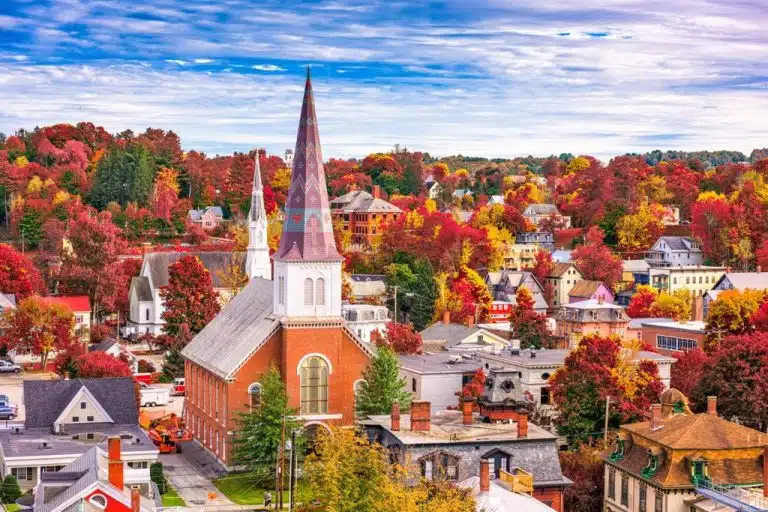
Vermont is the second-least populated state in the country with roughly 650,000 residents — smaller than most U.S. cities. But what it lacks in size, it makes up for in quality of life. The state consistently ranks among the safest, healthiest, and most educated in the nation. It also has one of the tightest labor markets in the country, with an unemployment rate of 2.6% — nearly half the national average — meaning employers are actively competing for workers.
That said, Vermont comes with real trade-offs. Housing costs have surged since the pandemic, the state income tax is among the highest in the nation (top rate 8.75%), and the cold, snowy winters aren’t for everyone. Burlington is the only city with a metro feel, and even it has just 45,000 residents. If you’re coming from a major metro, the adjustment to Vermont’s pace — limited retail, sparse nightlife, and rural infrastructure — can be significant.
This guide covers everything you need to evaluate a move to Vermont — housing costs, the job market, tax realities, and the interstate moving logistics unique to a New England relocation.
Pros of Moving to Vermont
✔ Extremely Low Unemployment: Vermont’s seasonally adjusted unemployment rate was 2.6% in November 2025 — one of the lowest in the nation and nearly half the 4.4% national average. Employers across the state are actively recruiting, and labor shortages in healthcare, skilled trades, hospitality, and education mean strong leverage for job seekers.
✔ Top-Ranked Safety and Quality of Life: Vermont consistently ranks as one of the safest states in the U.S., with some of the lowest violent crime rates in the country. The state also leads nationally in healthcare access, environmental quality, and civic engagement. It’s a state where community genuinely defines daily life.
✔ Unmatched Natural Beauty and Outdoor Recreation: Vermont’s landscape is its signature — the Green Mountains, Lake Champlain, the Long Trail, and some of the best skiing in the East (Stowe, Killington, Sugarbush, Mad River Glen). Fall foliage season is world-famous. The state has 55 state parks and a deep culture of hiking, cycling, skiing, and farm-to-table living.
✔ Strong Education System: Vermont’s public schools feature some of the smallest class sizes in the country, and the state invests heavily in per-pupil spending. Higher education options include the University of Vermont, Middlebury College, and Bennington College. The state also offers robust vocational and technical programs.
✔ No Sales Tax on Essentials: Vermont exempts groceries, clothing, and prescription drugs from its 6% state sales tax. Combined with the farm-to-table food culture and an emphasis on local agriculture, this makes everyday costs more manageable despite the higher-than-average overall cost of living.
Cons of Moving to Vermont
✘ One of the Highest State Income Taxes in the U.S.: Vermont’s top marginal income tax rate is 8.75% — among the highest in the country. The state also levies a property tax, estate tax, and a 6% sales tax (with exemptions). For high earners relocating from low-tax states, the tax burden is a significant adjustment.
✘ Expensive Housing With Limited Inventory: Vermont’s statewide median sale price reached $385,000 in 2025, with Chittenden County (Burlington area) hitting $500,000 for single-family homes. Decades of underbuilding, aging housing stock, and pandemic-era demand have created a genuine housing shortage. Inventory is ~10% higher than a year ago but still well below historical norms.
✘ Cold, Long Winters: Vermont winters are serious — average January highs in Burlington are around 27°F, with significant snowfall from November through April. Heating costs are substantial (many homes rely on fuel oil or propane), and winter driving requires snow tires or all-wheel drive. “Mud season” in late March through April can make rural roads impassable.
✘ Limited Urban Amenities: Burlington (pop. ~45,000) is Vermont’s largest city and the only one with anything approaching an urban retail and dining scene. There’s no major shopping mall in the state, no professional sports teams, and limited nightlife outside of Burlington. If you’re coming from Boston, New York, or another major metro, the adjustment is significant.
✘ Rural Infrastructure Challenges: Much of Vermont is deeply rural. Broadband internet coverage is still uneven outside of population centers. Cell service can be spotty in mountain valleys. Healthcare access requires longer drives in rural areas, and the state has an aging population that puts pressure on services.
Cost of Living in Vermont
Vermont’s cost of living is above the national average, driven primarily by housing and heating costs. The statewide median home sale price was approximately $385,000 in 2025 (Vermont Market Report/Redfin), with prices up roughly 5.8% year-over-year. In Chittenden County — which includes Burlington — the single-family median reached $500,000, and homes move faster than in the rest of the state.
Rents are also elevated, particularly in Burlington. A one-bedroom apartment in Burlington averages $2,237 (RentCafe, Jan 2026) — comparable to many larger New England cities. Outside of Chittenden County, rents drop significantly — towns like Rutland, Barre, and Brattleboro offer one-bedrooms in the $1,000–$1,400 range, though options are limited.
Heating costs are a major Vermont-specific expense. Many homes rely on fuel oil or propane, and winter heating bills can run $200–$400+/month from November through March. Vermont exempts groceries and clothing from its 6% sales tax, which helps offset everyday costs. Property taxes are above the national average — the statewide effective rate runs approximately 1.8–2.0% of assessed value, though rates vary significantly by town.
Cost of Living Comparison: Vermont Regions
Vermont’s cost of living varies significantly between the Burlington metro area and the state’s more rural regions:
| Expense Category | Burlington Area | Central VT (Montpelier/Barre) | Southern VT (Brattleboro/Rutland) | National Avg. |
|---|---|---|---|---|
| Avg. Rent (1-BR) | $2,237/mo | $1,200–$1,500/mo | $1,000–$1,400/mo | $1,650/mo |
| Avg. Rent (2-BR) | $2,460/mo | $1,400–$1,700/mo | $1,200–$1,600/mo | $1,950/mo |
| Median Home Sale Price | $500,000 (SF) | $325,000–$375,000 | $275,000–$350,000 | $412,500 |
| State Income Tax (Top Rate) | 8.75% (4 brackets: 3.35%, 6.60%, 7.60%, 8.75%) | Varies by state | ||
Sources: RentCafe (Jan 2026), Vermont Market Report/Hickok & Boardman (2025), Redfin (Jan 2026), SmartAsset (2025 tax brackets). Central and Southern VT rents estimated from regional listings and Apartments.com data.
Housing Market Trends in Vermont
Vermont’s housing market is stabilizing after years of pandemic-era disruption. The statewide median sale price was approximately $385,000 in 2025, up 5.8% year-over-year. Single-family homes specifically reached $435,000 statewide, while Chittenden County single-family homes hit $500,000. Unit sales increased nearly 6% statewide, signaling a healthier and more functional market.
In January 2026, Redfin reported a statewide median of $395,500, down 3.7% from the prior year — though this likely reflects seasonal variation and the small sample size (437 homes sold statewide in January). Homes spent a median of 91 days on market, and only 13.7% sold above list price (down from 20.2% a year ago). The sale-to-list ratio of 96.3% means buyers have significantly more negotiating power than at any point since 2020.
Vermont’s fundamental housing challenge is structural undersupply. Decades of underbuilding, an aging housing stock, and rising construction costs have created a deficit that population growth — even Vermont’s modest growth — has worsened. Inventory is about 10% higher than a year ago, but still well below what’s needed for a balanced market. First-time buyers remain at historic lows, while cash buyers and repeat buyers with substantial equity drive much of the activity.
Vermont Housing Market at a Glance
| Metric | VT (Statewide) | Chittenden County (Burlington) |
|---|---|---|
| Median Sale Price (2025) | $385,000 | $500,000 (SF) |
| YoY Price Change | +5.8% (2025 annual) | +2% (overall) |
| Days on Market (Jan 2026) | 91 | — |
| Sale-to-List Ratio | 96.3% | — |
| Homes Sold (Jan 2026) | 437 | — |
| Unit Sales YoY (2025 Annual) | +6% | +6% (SF: +10%) |
Sources: Hickok & Boardman Vermont Market Report (2025 annual), Redfin (Jan 2026), Catalyst Realty (Jan 2026).
Job Market and Employment in Vermont
Vermont’s labor market is one of the tightest in the country. The state’s seasonally adjusted unemployment rate was 2.6% in November 2025, well below the 4.4% national rate. The civilian labor force participation rate was 64.2%. This isn’t a function of booming job creation — Vermont’s economy is small — but rather a function of very low population, an aging workforce, and persistent labor shortages across nearly every sector.
Vermont’s economy is diversified for its size. Healthcare is the largest employer (UVM Medical Center, Dartmouth-Hitchcock affiliates), followed by education, tourism/hospitality, and manufacturing. GlobalFoundries operates a major semiconductor fabrication facility in Essex Junction. The insurance industry (National Life Group in Montpelier), specialty food production (Ben & Jerry’s, Cabot Creamery, Vermont Creamery), and a growing remote-work economy round out the landscape.
Vermont’s median household income is approximately $81,000 — above the national average and reflecting the state’s educated workforce. The state has a strong remote-work culture and previously offered a $7,500 relocation incentive for remote workers, though that program has been modified. Many newcomers to Vermont work remotely for companies based elsewhere while enjoying the state’s quality of life.
Vermont Job Market Overview
| Metric | Vermont | National |
|---|---|---|
| Unemployment Rate (Nov 2025) | 2.6% | 4.4% |
| Median Household Income | ~$81,000 | ~$77,000 |
| Top Income Tax Rate | 8.75% | Varies by state |
| Key Sectors | Healthcare, Education, Tourism, Manufacturing, Insurance | — |
| Major Employers | UVM Medical Center, GlobalFoundries, National Life Group | — |
Sources: VT Dept. of Labor (Nov 2025), U.S. Census Bureau (ACS), SmartAsset (2025 tax data).
Education and Schools in Vermont
Vermont invests more per pupil in K-12 education than nearly any other state, and class sizes are among the smallest in the country. The state’s public school system is organized into supervisory unions and districts, many of which serve small, rural communities. School choice is a distinctive Vermont feature — in many towns without their own high school, students receive tuition vouchers to attend the public or approved private school of their choice.
For higher education, Vermont punches well above its weight:
✔ University of Vermont (Burlington) — Vermont’s flagship public research university with strong programs in medicine, environmental science, and engineering
✔ Middlebury College — Top-ranked liberal arts college nationally, known for languages, environmental studies, and international programs
✔ Bennington College — Progressive, arts-focused liberal arts college
✔ Norwich University (Northfield) — The nation’s oldest private military college, with strong engineering and criminal justice programs
✔ Vermont State University — Formed in 2023 by merging Castleton, Northern Vermont, and Vermont Technical College into a single institution
The Community College of Vermont (12 locations statewide) provides affordable two-year degrees and workforce training throughout the state.
Resources for Moving to Vermont
Vermont requires new residents to update their identification and vehicle registration after establishing residency. Here are the essential resources:
✔ Transfer Your Driver’s License — Apply at a Vermont DMV office; you must surrender your out-of-state license
✔ Register Your Vehicle — Vermont requires annual vehicle inspection and registration; no vehicle property tax
✔ Register to Vote — Online registration through the Vermont Secretary of State
✔ Set Up Utilities — Green Mountain Power (largest electric provider), Vermont Gas Systems (Burlington area), or local electric co-ops. Many homes use fuel oil/propane for heat — arrange delivery before winter.
✔ Certificate of Insurance (COI) — Many apartment buildings and condo associations require a COI from your moving company before allowing access
How to Prepare for Your Move to Vermont
Vermont is a short-to-medium distance move from most of the Northeast corridor, but the state’s rural character and seasonal conditions add unique planning requirements. Having a solid moving checklist helps keep everything on track.
1. Time Your Move Carefully: Late spring through early fall (May–October) is ideal for moving to Vermont. Winter moves are possible but complicated — snow, ice, and narrow mountain roads can delay deliveries. Avoid “mud season” (late March through April) when rural dirt roads can become impassable. Book your long-distance move 4–6 weeks ahead.
2. Expect 1–3 Day Delivery Windows: Moves from Boston to Vermont typically take 1–2 days. From New York, 1–3 days. The distances are manageable, but access to rural properties can require smaller shuttle trucks for the final delivery — something your moving company should assess in advance.
3. Winterize Before Arrival: If you’re arriving before November, get your home winter-ready immediately — arrange heating fuel delivery (oil or propane), have the furnace inspected, and ensure snow removal is lined up. Many Vermont homes are older and may need weatherization improvements.
4. Get the Right Vehicle: All-wheel drive or four-wheel drive is essential in Vermont winters. Snow tires are not legally required but are universally recommended. Budget for a vehicle that can handle Vermont’s hills, snow, and unpaved roads.
5. Use Climate-Controlled Storage: If there’s a gap between your move-out and move-in dates, Vermont’s temperature extremes (below zero in winter, humid in summer) make climate-controlled storage essential for protecting furniture and electronics. Professional packing adds further protection during transit.
Get a Free Quote for Your Vermont Move
Whether you’re relocating to Burlington, settling into a mountain town like Stowe or Woodstock, or starting fresh in Vermont’s quieter corners, Poseidon Moving has the New England expertise and full-service moving infrastructure to handle your Vermont relocation — including packing, storage, and long-distance delivery.
Ready to start planning? Request your free moving quote today and let Poseidon Moving handle the logistics of your Vermont move.