What Is a Bill of Lading in Moving?
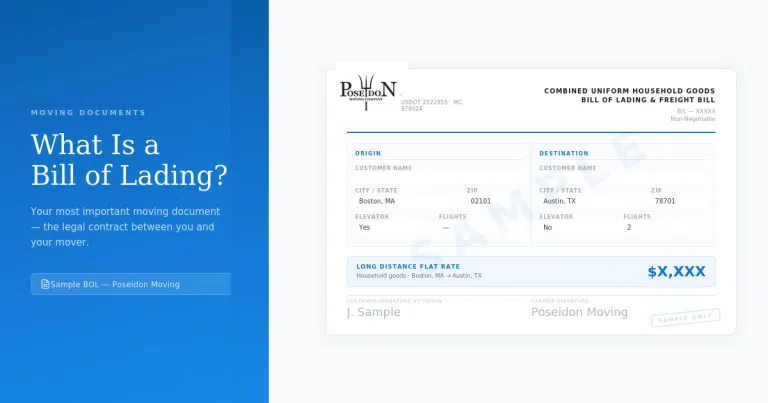
What Is a Bill of Lading? Your Most Important Moving Document Explained
A Bill of Lading (BOL) is the single most important document you’ll receive during a move. It serves as the legal contract between you and your moving company, confirming pickup and delivery details, the services included, your valuation choice, and the terms both parties agree to. If a dispute or damage claim arises later, the Bill of Lading is the first document everyone will look at.
Whether you’re moving across town or across the country, the Federal Motor Carrier Safety Administration (FMCSA) requires all licensed movers to issue a Bill of Lading before any items are transported. You’ll be asked to sign it before the move begins and again once the move is complete, ensuring both sides have a shared record of the scope of service, the condition of your items, and the final cost.
Bottom line: The Bill of Lading protects your rights, holds your moving company accountable, and serves as your official record of the entire move. Never start a move without one.
Why Is the Bill of Lading Important?
1. Proof of Agreement: The Bill of Lading confirms the services agreed upon and acts as the binding contract once signed by both parties.
2. Liability Reference: In the event of damage or loss, insurance claims and disputes refer back to what was documented in the Bill of Lading.
3. Regulatory Requirement: For interstate moves, federal regulations (FMCSA) require movers to issue a Bill of Lading before any items are transported.
4. Customer Protection: It helps you hold movers accountable and protects your legal rights if something goes wrong during the move.
What Paperwork Should You Receive from a Moving Company?
The Bill of Lading is one of several documents your mover should provide. Here’s the full list of moving paperwork you should expect:
✔ Written estimate (binding or nonbinding, depending on move type and company)
✔ Order for service / confirmation of dates and scope
✔ Bill of Lading (BOL)
✔ Inventory or item list (sometimes attached to the BOL)
✔ Valuation selection / liability coverage acknowledgment
✔ Receipt and payment record
✔ Claims instructions and timelines (especially important for damage claims)
What Information Is Included in a Bill of Lading?
The Bill of Lading isn’t just a signature form. It’s a detailed breakdown of your move that documents all essential details of your service agreement, inventory, pricing, and liability terms in one place. This ensures you and the moving company have a shared understanding of what’s included and how your move will be carried out.
A standard Bill of Lading typically includes:
✔ Your name, address, and contact information
✔ Pickup and delivery dates and addresses
✔ Inventory summary or item list
✔ Total charges and pricing breakdown
✔ Chosen valuation coverage (basic liability or full value protection)
✔ Signatures of both you and the moving foreman
✔ Special instructions or notations about fragile or high-value items
Is the Bill of Lading the Same as the Moving Estimate?
No. They’re related but serve different purposes. The moving estimate provides a projected cost based on your initial inventory and requested services like packing, loading, or storage. It’s an important planning tool, but a non-binding estimate is not a final price.
The Bill of Lading is the final, legally binding contract. It reflects the actual services performed, including any changes to packing needs, inventory, scope, or pricing. If the final weight, volume, or service level differs from the original estimate, the Bill of Lading determines the official amount due.
✔ Key takeaway: Always compare your Bill of Lading to your original estimate before signing. If the numbers don’t match, ask your mover to explain the difference.
Common Bill of Lading Mistakes to Avoid
Your Bill of Lading should be fully accurate and complete before you sign. Watch for these common red flags:
✗ Blank fields: Never sign a Bill of Lading that isn’t fully filled out. Empty fields can be changed after the fact.
✗ Hidden fees: Cross-check the Bill of Lading with your original estimate to catch any charges that weren’t discussed.
✗ Incorrect details: Wrong delivery address or valuation selection can lead to costly issues that are difficult to reverse.
✗ Unsigned documents: If either party fails to sign, it weakens your legal protection in the event of a dispute.
If anything looks off, pause the move and ask for clarification before proceeding. A reputable mover will never pressure you to sign without reviewing the document first.
What Should You Do with Your Bill of Lading After the Move?
Once your Bill of Lading is signed and the move is complete, save both a digital and printed copy for your records. This document acts as your official proof of service, detailing what was moved, when it was moved, and under what terms. If you ever need to file a damage claim, verify charges, or settle a dispute with your mover, the Bill of Lading will be the first point of reference.
Treat it like a receipt, a contract, and an insurance safeguard all in one. Most movers recommend keeping your Bill of Lading for at least one year after your move, and longer if you have items in storage or an open claim.
At Poseidon Moving, we review the Bill of Lading with every customer before and after the move so nothing is left unclear. From service details to valuation coverage, we make sure you understand what you’re signing and what it means for your protection.
Request a free quote and experience a moving process built on clarity and trust.