617-470-9950 Toll Free 866-565-1516

How to Pack for a Move: Step-by-Step Packing Guide

Professional packing services by Poseidon Moving & Storage

Packing is where most moves go wrong — not because people don’t try, but because they start without a plan and run out of time, tape, or patience halfway through the kitchen. This guide breaks the entire process into a clear timeline, walks through every room and item type, and gives you the specific techniques professional packers use to get a three-bedroom home boxed up in a single day.

Whether you’re handling a local move or a long-distance relocation, the principles are the same: start early, work room by room, protect the fragile stuff, and label everything. Use our moving checklist alongside this guide to stay on track.

Your Packing Timeline: When to Pack What

The number one packing mistake is starting too late. Follow this countdown so you’re not panic-boxing at midnight before the truck arrives.

6 weeks out → Declutter aggressively. Go room by room and separate items into keep, donate, and trash. Every item you get rid of now is a box you don’t have to pack, move, or unpack. Sell valuable items online, donate usable goods, and schedule a junk removal pickup for the rest.

4 weeks out → Stock up on packing supplies (see the table below) and start packing rooms you don’t use daily — guest bedrooms, storage closets, the garage, seasonal items, books, and décor.

2 weeks out → Pack the bulk of your home. Kitchen (leave out a few essentials), living room, dining room, home office, kids’ rooms. Disassemble furniture that needs to be taken apart.

1 week out → Pack everything except daily essentials. Defrost the freezer, empty the fridge, and prepare an overnight bag for each family member (phone charger, medications, change of clothes, toiletries).

Moving day → Pack your bedding, bathroom supplies, and final kitchen items. Load your overnight bags into your personal car — not the truck.

Short on time? If you’re facing a last-minute move, check our packing hacks guide for shortcuts that save hours — like leaving clothes on hangers in garbage bags and keeping dresser drawers full.

Packing Supplies: What You Need and How Much

Running out of tape at 9 PM on a Sunday is avoidable. Stock up on everything before you start. The table below gives you a rough count based on home size — adjust up for homes with lots of kitchen items, books, or collectibles. For a deeper breakdown of box types and sizes, see our complete guide to moving boxes.

Supply Studio / 1BR 2BR 3BR+
Small boxes (books, heavy items) 10 15–20 25–30
Medium boxes (kitchen, general items) 10–15 20–25 30–40
Large boxes (linens, pillows, light items) 5–8 10–15 15–20
Dish pack / glass divider boxes 1–2 2–3 3–5
Wardrobe boxes 1–2 2–4 4–6
Packing tape (rolls) 3–4 5–6 8–10
Bubble wrap (feet) 50 ft 100 ft 150+ ft
Packing paper (lbs) 10 lbs 15–20 lbs 25+ lbs
Stretch wrap (rolls) 1 1–2 2–3
Markers + labels 2 markers 3 markers 4+ markers

You can purchase supplies individually or save time with Poseidon Moving’s packing material kits, which include everything above in pre-bundled packages sized by home.

Box Packing Fundamentals

Before you pack a single item, these rules apply to every box in your move:

Heavy items go in small boxes, light items go in large boxes. A large box full of books will weigh 70+ lbs, the bottom will give out, and someone’s going to get hurt. Keep every box under 50 lbs.

Reinforce the bottom of every box. Run an extra strip of packing tape along the bottom seam in an H-pattern (one strip down the center, one across each side). This is the joint most likely to fail.

Fill empty space. Shifting is what breaks things. If there’s room left in a box after you’ve packed it, fill the gaps with packing paper, towels, or clothing. The box should feel solid when you close it — nothing should move when you tilt it.

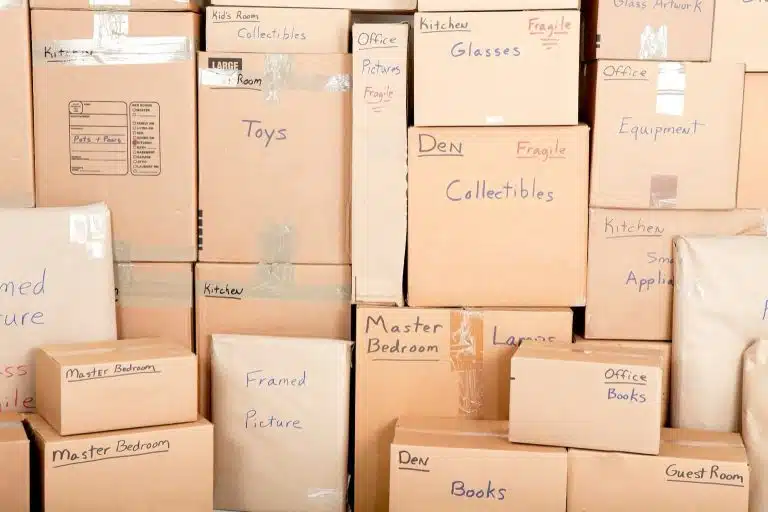
Label on two sides plus the top. Write the destination room and a brief summary of contents (e.g., “Kitchen — pots & baking sheets”). If the box contains fragile items, write “FRAGILE” and draw an arrow indicating which side faces up.

Don’t overpack or underpack. An overstuffed box won’t close properly and can’t be stacked. An underfilled box will crush under the weight of boxes stacked on top of it.

Kitchen and Dining Room

The kitchen is the hardest room to pack because it’s full of breakable, oddly shaped, and heavy items. Plan for it to take the longest and start here first (after decluttering).

Plates and bowls → Wrap each one individually in packing paper or a dish towel. Stack plates vertically on their edges (like records), not flat — vertical stacking distributes impact force better and significantly reduces breakage. Use dish pack boxes with built-in dividers for best results.

Glasses and stemware → Stuff the inside of each glass with crumpled packing paper, then wrap the outside. Place glasses upside down in a box with dividers. Wine glasses and champagne flutes are especially fragile — wrap the stem separately and add extra cushioning around the base.

Pots, pans, and bakeware → Stack pots with a layer of packing paper between each one to prevent scratching. Wrap lids separately. Baking sheets and cutting boards can be packed vertically in a medium box with cardboard between them.

Small appliances → Use original boxes if you have them. If not, wrap each appliance in bubble wrap, secure cords with rubber bands or twist ties, and pack in a snug box. Blenders, food processors, and stand mixers should have all detachable parts wrapped and packed separately.

Knives → Wrap each blade individually in thick packing paper or a dish towel, then slide into a knife guard, knife roll, or a sturdy box. Label the box “Sharp Objects” on all sides.

Double-boxing for long-distance moves: If you’re moving interstate or cross-country, pack your most fragile kitchen items in a box, then place that box inside a slightly larger box with padding in between. The extra layer absorbs road vibration over hundreds of miles.

Electronics and Screens

Electronics are expensive to replace and easy to damage if not packed correctly. The key is keeping screens protected, cords organized, and components together.

TVs and monitors → Original box and foam inserts are ideal. Without them, wrap the screen in a soft blanket or anti-static material, attach foam corner protectors, and slide the unit into a reinforced box as close to the TV’s dimensions as possible. Always transport screens upright, never flat.

Computers and laptops → Back up all data before packing. Wrap laptops in a padded sleeve and pack inside a carry-on bag — keep this with you, not on the truck. Desktop towers should be packed in their original box or wrapped in bubble wrap with extra padding around the hard drive.

Cords and accessories → Before unplugging anything, photograph the back of each setup (TV, gaming console, router, home office) so you have a wiring reference. Label each cord with masking tape and a marker, then coil and place them in labeled ziplock bags. Pack these bags in the same box as the device they belong to.

Keep remotes with their devices. Tape the remote to the device itself (or place it in the same box with a note). Reuniting orphaned remotes with their electronics after a move is surprisingly time-consuming.

Furniture, Mirrors, and Wall Art

Furniture is usually the easiest category to damage — not from dropping, but from doorframe dings, surface scratches, and lost hardware during disassembly.

Tables, dressers, and bed frames → Remove legs, shelves, and any detachable parts. Put all screws, bolts, and Allen keys in a ziplock bag and tape it directly to the furniture piece they came from. Wrap surfaces in moving blankets or stretch wrap to prevent scratches.

Mirrors and glass → Apply painter’s tape in an X-pattern across the glass surface — this won’t prevent breaking, but it holds shards together if the glass does crack. Wrap in bubble wrap, add corner protectors, and place in a mirror/picture box. Mark the box “GLASS — FRAGILE” and store it upright, never flat.

Framed artwork and pictures → Use the same painter’s-tape-X method on glass-covered frames. Wrap in bubble wrap, then place inside a flat, reinforced picture box with cardboard between each piece. Always store and transport art upright.

Lamps → Remove the shade and wrap it in packing paper (never bubble wrap — it can leave texture marks on fabric shades). Wrap the base separately in bubble wrap. Pack the shade in its own box with padding so nothing rests on top of it.

Clothing, Shoes, and Personal Items

Clothing is bulky but almost never fragile, which makes it one of the faster categories to pack — and a great source of free padding for everything else.

Everyday clothes → Fold or roll and pack in large boxes or suitcases. Rolling saves more space and reduces wrinkles. Use vacuum-sealed bags for out-of-season items to compress bulk.

Suits, dresses, and formalwear → Use wardrobe boxes with the built-in hanging bar, or place them in garment bags first. For packing a suit in a suitcase, fold the jacket inside-out (lining facing out) to protect the outer fabric, then fold in thirds.

Shoes → Stuff each shoe with packing paper or socks to hold its shape. Pack in original boxes if available, or wrap pairs together in packing paper and line them along the bottom of a medium box.

Toiletries and liquids → Unscrew caps, place a square of plastic wrap over the opening, and re-screw the cap. This prevents leaks. Stand bottles upright in a small box lined with a garbage bag (as a secondary leak barrier). Keep medications in your overnight bag, not on the truck.

Jewelry and small valuables → Thread necklaces through straws to prevent tangling. Use egg cartons or pill organizers for earrings and rings. Pack these in a carry-on bag that stays with you.

Bedding, Linens, and Rugs

Soft items are the easiest things in your house to pack — and they double as padding for everything else.

Blankets, comforters, and sheets → Use vacuum-sealed bags to compress bulky bedding down to a fraction of its size. If you don’t have vacuum bags, fold tightly and pack in large boxes or garbage bags. These also make excellent padding between furniture pieces in the truck.

Pillows → Pack in large garbage bags or vacuum bags. Pillows can fill awkward gaps in the moving truck and prevent other items from shifting.

Rugs → Roll tightly (don’t fold — folding creates permanent creases), secure with stretch wrap or rope, and protect the ends with cardboard. For large area rugs, stand them upright in the truck to save floor space.

Special Items: Plants, Weights, Records, and Collections

Some items don’t fit neatly into a room-by-room system. Here’s how to handle the outliers.

Houseplants → Use breathable containers (open-top boxes or paper bags) and keep them in your personal car if possible, since moving trucks have no climate control. Water plants a day or two before the move — not the morning of — to reduce weight and prevent soil spillage. Note: some states restrict transporting plants across state lines, so check regulations if you’re moving cross-country.

Gym equipment and weights → Use small, reinforced boxes and keep each box well under 50 lbs. Wrap individual weights in towels to prevent them from clanging together and damaging other items. Disassemble anything with removable parts and bag the hardware.

Vinyl records → Pack records upright (like books on a shelf) in small, sturdy boxes. Never stack them flat — the weight causes warping. Keep records in their sleeves and place a piece of cardboard between every 5–10 records for rigidity.

Wine bottles → Pack upright in specialty wine boxes or cell divider boxes. Wrap each bottle in packing paper. If you don’t have dividers, wrap bottles individually and pack them snugly in a small box with no room to shift.

Yard tools → Bundle long-handled tools (rakes, shovels, brooms) together with zip ties or rope. Cover sharp blades with cardboard secured by tape. These can be loaded standing up along the inside wall of the truck.

Items movers won’t transport: Hazardous materials (gasoline, propane tanks, paint thinner, batteries, cleaning chemicals with bleach or ammonia), perishable food, and firearms typically cannot go on the truck. Dispose of or transport these yourself. If you need to move unusually heavy items like safes, pianos, or large appliances, ask your movers about specialty handling in advance.

Loading the Moving Truck

How you load the truck matters as much as how you packed the boxes. A poorly loaded truck leads to shifting, crushing, and breakage — even if every box was packed perfectly.

Layer 1 (back wall) → Heaviest items first. Appliances, dressers, bookshelves, and mattresses (stood upright) go flat against the back wall. Use tie-down straps to secure everything so nothing shifts during turns and stops.

Layer 2 → Large and medium boxes, stacked heaviest on the bottom. Fill vertical gaps with rolled rugs, long tools, and floor lamps.

Layer 3 (near the door) → Light boxes, fragile items, and anything labeled “FRAGILE” or “Open First.” These load last so they come off first.

Fill every gap → Pillows, blankets, sofa cushions, and garbage bags of clothing all make excellent gap fillers. Air gaps allow boxes to shift, which is the leading cause of in-transit damage.

Mattress care: Use a mattress bag or heavy-duty plastic wrap to protect against dirt, moisture, and tearing. Mattresses should be stood upright and strapped securely — laying them flat with boxes stacked on top can damage the springs or foam.

Let Professionals Handle the Packing

Packing a full home takes most people 2–3 weekends. Our crews do it in a day — with professional-grade materials and techniques that keep everything protected during transit. Poseidon Moving offers full and partial packing services for local, long-distance, and interstate moves. We wrap, box, label, and load — you focus on everything else.

Request a free quote and tell us what you need — whether it’s the whole house or just the kitchen and china cabinet.


Frequently Asked Questions

How far in advance should I start packing?+
Start 4–6 weeks before your move. Begin with rooms you use least — guest bedrooms, storage closets, seasonal items, and books. Tackle the kitchen and bathrooms during the final week. Leave bedding, daily toiletries, and one set of dishes for last. If you only have 1–2 weeks, skip the room-by-room approach and focus on packing by priority: fragile items first (they take the most time), then bulky items, then everything else.
What should I not pack in moving boxes?+
Don’t pack hazardous materials (gasoline, propane, paint thinner, bleach, lighter fluid, car batteries), perishable food, or important personal documents (IDs, passports, birth certificates, financial records). Hazardous items cannot go on a moving truck. Personal documents and irreplaceable items like family photos, jewelry, and medication should travel with you in your car.
How many boxes do I need for a 2-bedroom apartment?+
A typical 2-bedroom apartment requires 40–60 boxes total: about 15–20 small, 20–25 medium, and 10–15 large, plus 2–3 dish pack boxes and 2–4 wardrobe boxes. The actual number depends on how much you’ve decluttered and how dense your belongings are. Homes with large book collections, full kitchens, or lots of décor will be on the higher end. See our moving box guide for a full breakdown of sizes and what goes in each.
What’s the safest way to pack dishes and glassware?+
Wrap each piece individually in packing paper (or a dish towel for an eco-friendly alternative). Place plates vertically on their edges inside a dish pack box — stacking plates flat increases the chance of breakage from weight. Stuff the interior of glasses with crumpled paper, wrap the outside, and place them upside down with dividers between each one. Fill all remaining space in the box with padding. For long-distance moves, double-box your most fragile pieces.
Should I pack my TV in a box or can the movers wrap it?+
Boxing a TV is always safer than a blanket wrap alone, especially for long-distance moves where items spend more time in transit. Use the original box and foam inserts if you have them. If not, wrap the screen in a soft blanket or anti-static material, secure foam corner protectors, and place it in a reinforced box sized as close to the TV as possible. Always transport TVs upright — laying them flat risks cracking the screen from vibration. Professional packing services include specialty TV and monitor handling.
Can Poseidon Moving pack my home for me?+
Yes — we offer full-service and partial packing for any size move. Our trained crew brings all materials (boxes, tape, bubble wrap, packing paper, specialty cartons) and packs room by room, labeling everything by destination room and contents. We handle fragile items, electronics, artwork, and furniture disassembly. You can also choose partial packing — for example, having us pack just the kitchen and china while you handle the rest. Request a free quote to get started.
Read More

Moving Pods Cost and Size Guide: Which One is Best for Your Move

Poseidon Moving Company truck driving on the road during a move

How Much Do Moving Pods Cost? Pricing, Sizes & Best Companies

Moving can be overwhelming, and choosing the right moving method depends on your budget, schedule, and level of involvement. While some people prefer full-service moving companies to handle everything from packing to transportation, others go for moving pods as a flexible, self-service alternative.

Moving pods provide a middle ground between renting a moving truck and hiring professional movers. They allow you to pack at your own pace while avoiding the responsibility of driving a large vehicle. However, costs vary based on distance, container size, rental duration, and the company you choose.

But how much do pods cost for moving? What size do you need? And which company offers the best value? In this guide, we’ll break down everything you need to know about moving pod costs, sizes, pros and cons, and the best moving pod companies so you can make an informed decision that fits your needs.

What Are Moving Pods and How Do They Work?

Moving pods are portable storage containers that provide a flexible alternative to renting a moving truck or hiring a full-service moving company. Whether you’re planning a local move or a long-distance relocation, these containers are delivered directly to your home, allowing you to pack and load your belongings at your own pace. Once ready, the company picks up the pod and transports it to your new home or a secure storage facility for temporary holding, making it a convenient option for both short-distance and interstate moves.

How Moving Pods Work:

1. Delivery: The moving pod is dropped off at your location.
2. Packing & Loading: You pack and load your belongings on your schedule.
3. Pickup & Transport: The company picks up the pod and moves it to your destination.
4. Unloading & Return: You unload your items, and the company retrieves the empty container.

Pros of Using Moving Pods

Using moving pods can be a convenient and flexible option for those who prefer a DIY moving approach without the hassle of driving a large truck. Here are some key advantages:

No Driving Required: Unlike rental trucks, you won’t have to navigate a large moving vehicle across long distances.
Flexible Timing: Pack and load at your own pace without feeling rushed by a tight schedule.
Storage Option: If your new home isn’t ready yet, pods can be stored at a secure facility until you’re ready for delivery.
Cost-Effective for Long-Distance Moves: Moving pods can often be more affordable than hiring full-service movers, depending on time of the year distance and container size.
Secure & Weatherproof: Moving pods are built to protect your belongings from rain, wind, and other environmental factors.

Cons of Using Moving Pods

While moving pods offer flexibility, they may not be the best fit for every situation. Here are some potential downsides to consider:

Limited Space: If you have a large household, you may need multiple pods, which can increase costs.
Parking Restrictions: Some neighborhoods and apartment complexes don’t allow pods to be parked in driveways or streets for long periods.
Delivery Scheduling: Availability can be limited during peak moving seasons, so booking in advance is essential.
Weight Limits: Each pod has a maximum weight capacity, and exceeding it can result in extra charges or require an additional container.
Not Ideal for Last-Minute Moves: Since moving pods require delivery coordination, they may not be the best choice for those who need to move on short notice.

How Much Do Moving Pods Cost?

When planning a move, cost is one of the biggest deciding factors in choosing between moving pods, rental trucks, or full-service movers. Moving pods can be a cost-effective and flexible option, but pricing varies based on several factors, including distance, pod size, rental duration, and whether you need storage.

Unlike traditional moving companies, where pricing includes labor and transportation, moving pod costs primarily cover the container rental and transport. While this can be a more budget-friendly choice for DIY movers, additional fees for storage, packing materials, and labor assistance can add up. Understanding these pricing details upfront helps ensure you’re making the best decision for your move.

Comparing moving container costs across different providers can help you choose the best option for your relocation needs. Below is a breakdown of estimated pricing for various move types:

Move Type PODS
(8′, 12′, 16′)
1-800-PACK-RAT
(8′, 12′, 16′)
U-Haul U-Box
(8′)
Zippy Shell
(10′, 15′)
U-Pack
(ReloCube / Trailer)
Local Move (Under 100 miles) $299 – $499 $700 – $2,000 $500 – $1,000 $600 – $1,800 N/A
Medium Distance (100 – 500 miles) $1,000 – $2,500 $1,800 – $4,000 $1,200 – $2,800 $1,500 – $4,500 $1,800 – $4,500
Long-Distance Move (500 – 1,500 miles) $1,500 – $4,500 $2,500 – $6,500 $1,500 – $3,500 $2,500 – $6,000 $2,500 – $7,500
Cross-Country Move (1,500+ miles) $3,000 – $6,500 $4,500 – $8,000 $2,000 – $5,000 $3,500 – $7,000 $3,500 – $9,000
Storage Fees (Monthly) $150 – $300 $190 – $300 $90 – $100 $149 – $200 N/A (only transit storage)
Delivery & Pickup Fees Included in price Included in price $99 – $150 per trip Included Included
Customer Ratings ⭐⭐⭐⭐ (4.2/5) ⭐⭐⭐⭐⭐ (4.4/5) ⭐⭐⭐⭐ (4.0/5) ⭐⭐⭐⭐ (4.3/5) ⭐⭐⭐⭐⭐ (4.5/5)

Pod versus full service snapshot: Compare pod costs versus full service moving by first understanding how moving companies calculate pricing. Use our moving cost calculator to estimate your total cost to move.

Showing estimates for: Studio / 1 Bedroom | Long Distance (Up to 1,000 mi)
PODS
Container Rental
Rental cost only —
add materials & labor
DIY Truck
Rent-a-Truck
Rental cost only —
add fuel & materials
Full-ServicePOSEIDON
Professional Movers
Includes labor, equipment,
materials & travel
Verdict

Estimates based on industry averages and 2025–2026 data. Actual costs vary by inventory, access, and time of year.

How Big Are Moving Pods? Size Guide & Choosing the Right One

Selecting the right moving pod size is crucial to ensuring you have enough space for your belongings without overpaying for unnecessary storage. Moving pod dimensions vary by company, with different options designed to accommodate small apartments, multi-bedroom homes, and everything in between.

So, how big are moving pods? The most common sizes include small (8 ft), medium (12 ft), and large (16 ft) containers, but some companies offer alternative sizes, such as U-Pack’s ReloCube or Zippy Shell’s 10- and 15-ft units. Each pod has capacity limits based on both square footage and weight restrictions, so it’s important to plan your packing efficiently to maximize space.

To determine how much furniture fits in a moving pod, consider factors like furniture size, box count, and whether large items are disassembled. Choosing the right moving pod size depends on the number of rooms you’re moving, but as a general rule, a small pod fits a studio or one-bedroom apartment, while a large pod can accommodate a three-bedroom home.

Below is a breakdown of PODS container sizes explained alongside other popular moving pod providers:

Company Container Sizes (ft.) Container Dimensions (L x W x H) Space Capacity (cu. ft.) Weight Limit What It Fits
PODS 8′
12′
16′
8′ x 7′ x 8′
12′ x 8′ x 8′
16′ x 8′ x 8′
402
689
835
4,200 lbs
4,700 lbs
4,200 lbs
1 room
2-3 rooms
3-4 rooms
1-800-PACK-RAT 8′
12′
16′
8′ x 7.2′ x 7.8′
12′ x 7.2′ x 7.8′
16′ x 7.2′ x 7.8′
404
620
830
6,000 lbs
6,000 lbs
6,000 lbs
1 room
2-3 rooms
3-4 rooms
U-Haul U-Box 8′ 8′ x 5′ x 7.5′ 257 2,000 lbs 1-2 rooms
Zippy Shell 10′
15′
10′ x 7′ x 7′
15′ x 7′ x 7′
380
640
4,500 lbs
4,500 lbs
2 rooms
3 rooms
U-Pack ReloCube 7′
28′ Trailer
7′ x 6′ x 8′ (per cube)
28′ x 8′ x 9′ (trailer)
305 per cube
Variable in trailer
2,500 lbs (ReloCube)
Variable
1 room per cube
Whole home

How to Pack a Moving Pod Like a Pro

Unlike traditional moving companies, moving pods (also known as portable containers) do not come with professional packers and movers to handle loading or unloading at either location. This means you’re responsible for safely packing, securing, and maximizing space inside your pod. Additionally, moving pod companies do not supply packing materials, such as furniture blankets or stretch wrap, which are essential for protecting your belongings during transit.

That’s where Poseidon Moving can help. No matter where your moving pod or portable container is located, our professional movers can assist with expert packing, loading, and unloading services. We ensure your items are properly wrapped, secured, and stacked efficiently to prevent shifting and damage while in transit.

To make the most of your moving pod, it’s important to use sturdy boxes, disassemble large furniture, and distribute weight evenly. Placing heavier items at the bottom and using straps to secure furniture will help protect your belongings. If you need packing supplies, labor assistance, or professional guidance, Poseidon Moving is here to help, making your moving pod experience smooth and efficient.

Moving with Poseidon Moving: The Help You Need for a Smooth Move

Choosing a moving pod instead of a full-service moving company gives you flexibility, but it also means handling packing, loading, and unloading on your own—and that can be overwhelming. If you’re looking for experienced movers to load a container, unload a moving pod, or help with packing and wrapping materials, Poseidon Moving is here to make your move easier.

We specialize in assisting DIY movers who choose portable storage solutions but still need professional help with the heavy lifting. Whether your pod is at your home, an apartment complex, or a storage facility, our team ensures your furniture is disassembled, wrapped for protection, loaded securely, and ready for transit. When you arrive at your destination, we’ll also be there to unload, reassemble, and set up your furniture so you can settle in faster.

No matter where you’re moving, Poseidon Moving provides expert labor services to make sure your pod is packed efficiently and your belongings are protected. Contact us today for a free quote and let our skilled movers handle the heavy lifting, so you don’t have to.

Get matched with Poseidon Moving in your area. Click your state for personalized moving services and estimates.

Frequently Asked Questions

It depends on the size of your move and the distance. For local moves and smaller households, PODS can be more affordable since you handle the packing and loading yourself. However, for larger or long-distance moves, a full-service moving company like Poseidon Moving may offer better value when you factor in the time, labor, packing materials, and potential for multiple containers. Use our moving cost calculator to compare your options.
Most moving pod companies allow you to keep the container at your location for about 30 days, with options to extend for an additional monthly fee. However, local regulations and HOA rules may limit how long a pod can sit in your driveway or on the street. Always check with your city or neighborhood association before scheduling delivery.
Yes! While moving pod companies don't typically provide labor, you can hire professional movers like Poseidon Moving to handle the heavy lifting. Our team can pack, wrap, load, and unload your pod at both your origin and destination, ensuring your belongings are protected and efficiently organized for transit.
Read More

What to Know Before Moving to Georgia

Moving to Georgia: Cost of Living, Jobs, Housing, and Everything You Need to Know

Georgia has become one of the most sought-after states for relocation, offering big-city opportunities, small-town charm, and everything in between. Whether you’re chasing career growth in Atlanta, looking for coastal living in Savannah, or seeking affordable suburban life in Augusta, Georgia has something for everyone.

Beyond its competitive cost of living and strong job market, Georgia attracts newcomers with its warm climate, vibrant culture, and endless outdoor adventures. Imagine spending weekends hiking in the Blue Ridge Mountains, kayaking along the Chattahoochee River, or enjoying live music and Southern cuisine in bustling downtown districts.

But moving interstate is more than just picking a city. It’s about knowing what to expect and how to prepare. This guide covers everything you need to know about relocating to Georgia — from housing and job opportunities to cost of living and local resources.

Pros of Moving to Georgia

Competitive Cost of Living: Georgia’s statewide median home sale price is $360,000 — roughly in line with the national median — but cities like Augusta ($200,000) and Savannah ($350,000) offer well below the national average. Rents, groceries, and utilities are also lower than most comparable metro areas.

Strong Job Market: Georgia’s unemployment rate sits at 3.6% (Dec 2025), below the national average. The state is home to major employers like The Home Depot, UPS, Coca-Cola, and Delta Airlines, with strong growth in healthcare, tech, logistics, and film production. Atlanta is one of the fastest-growing metro areas in the country.

Mild Climate: Georgia offers warm summers and mild winters — no heavy snowfall or frozen commutes. If you prefer sunshine over snow shovels, this might be your ideal state.

Outdoor Activities and Attractions: From the Blue Ridge Mountains to Savannah’s beaches, Georgia is perfect for hiking, fishing, and boating. Whether you’re an adventure seeker or someone who enjoys a scenic weekend escape, there’s something for everyone.

Retirement-Friendly Tax Policies: Georgia does not tax Social Security income, and retirees over 65 can exclude up to $65,000 per person in retirement income. This makes it one of the best states for retirees looking to stretch their savings.

Cons of Moving to Georgia

Hot and Humid Summers: Georgia’s summers are no joke. With humidity levels regularly above 70% and temperatures exceeding 90°F from June through September, it can feel sweltering — especially for newcomers from cooler climates.

Heavy Traffic in Atlanta: Atlanta’s traffic ranks among the worst in the U.S., with commute times 35% longer than the national average. If you plan to live in or around the city, expect significant congestion during rush hour.

Higher Sales Tax in Some Counties: While the state sales tax is 4%, local county taxes can push combined rates up to 9%, making everyday purchases more expensive depending on where you live.

Cost of Living in Georgia

One of the biggest reasons people choose to move to Georgia is its affordability. The state offers competitive housing costs, lower utilities, and more budget-friendly everyday expenses than many other parts of the country.

Housing is the most significant variable. The statewide median sale price is $360,000 (2025 year-end), but that number is heavily influenced by Atlanta. In Savannah, the median home sells for around $350,000, while Augusta comes in near $200,000 — well below the national average. Renters also benefit: one-bedroom apartments in Augusta average around $1,095/month, compared to $1,600 in Atlanta.

Beyond housing, Georgia residents enjoy lower-than-average grocery costs, gas prices, and utilities. One factor to keep in mind is sales tax, which varies by county — the state base rate is 4%, but combined local rates can reach as high as 9%.

Cost of Living Comparison: Georgia vs. National Average

Georgia offers a competitive cost of living compared to the national average. Below is a breakdown of key expense categories across the state and its major cities:

Expense Category National Avg Atlanta Savannah Augusta
Median Home Price $368,200 $411,000 $350,000 $200,000
Rent (1-Bedroom) $1,640/mo $1,600/mo $1,500/mo $1,095/mo
Rent (2-Bedroom) $1,950/mo $1,870/mo $1,750/mo $1,245/mo
Utilities (Monthly) $150 $150 $145 $135
Gas (Per Gallon) $3.20 $2.80 $2.80 $2.75
Sales Tax Rate Varies 8.9% 7% 8%

Sources: Redfin (Dec 2025), RentCafe (2025), Apartments.com (2025), GA Dept. of Labor. National rent averages from Apartments.com. Home prices are median sale prices.

Housing Market Trends in Georgia

The Georgia housing market is moving toward balance between buyers and sellers after years of red-hot seller conditions. According to the Georgia REALTORS® 2025 Annual Report, the statewide median sale price held steady at $360,000 (flat year-over-year), while new listings rose 7.8% and available inventory climbed 13.1%. Homes are taking longer to sell — an average of 56 days on market, up 21.7% from the prior year — giving buyers more time and negotiating leverage.

Atlanta remains the most expensive market in the state, with a median sale price around $411,000 (Atlanta REALTORS®, Sept 2025). Savannah’s market is moderating after recent gains, with a median of $350,000 and 88 days on market. Augusta remains one of the most affordable cities in the state at $200,000 median, with homes selling in about 77 days.

For renters, Georgia offers a wide range of price points. One-bedroom apartments in Atlanta average around $1,600/month, Savannah around $1,500/month, and Augusta around $1,095/month — well below Atlanta pricing.

Georgia Housing Market at a Glance

Metric Georgia Atlanta Savannah Augusta
Median Sale Price $360,000 $411,000 $350,000 $200,000
YoY Price Change 0.0% +8.5% +2.5% -0.05%
Avg. Rent (1-BR) $1,300/mo $1,600/mo $1,500/mo $1,095/mo
Days on Market 56 63 88 77
Homes for Sale 40,189

Sources: GA REALTORS® 2025 Annual Report (Feb 2026), Atlanta REALTORS® (Sept 2025), Redfin city-level data (Nov–Dec 2025), RentCafe (2025).

Job Market and Employment in Georgia

Georgia’s job market is strong and diversified. The state’s unemployment rate was 3.6% as of December 2025, below the national average, with nearly 5 million jobs statewide. Healthcare, education, administrative services, and professional/technical services led recent job growth, with private education and healthcare reaching an all-time employment high in late 2025.

Atlanta is the economic engine — a hub for finance, tech, logistics, and corporate headquarters. Savannah’s economy is driven by its deep-water port (one of the busiest on the East Coast), advanced manufacturing, aerospace (Gulfstream), and a fast-growing film and entertainment sector. Augusta anchors its economy around healthcare (Augusta University Medical Center), the military (Fort Eisenhower), and the Savannah River Site.

Corporate giants headquartered in Georgia include The Home Depot, UPS, Delta Airlines, Coca-Cola, Aflac, Southern Company, and NCR Voyix. The state’s business-friendly tax environment and relatively low operating costs continue to attract relocations and expansions.

Georgia Job Market Overview

Metric Georgia Atlanta Metro Savannah Augusta
Unemployment Rate 3.6% 3.2% 3.5% 3.6%
Total Jobs (Statewide) 4,991,700
Top Industries Healthcare, Trade, Logistics Tech, Finance, Logistics Port/Shipping, Aerospace, Tourism Healthcare, Military, Energy
Major Employers Home Depot, UPS, Delta, Coca-Cola Delta, Home Depot, NCR Voyix Gulfstream, GA Ports Authority Augusta Univ., Fort Eisenhower

Sources: GA Dept. of Labor (Dec 2025), BLS/FRED (Dec 2025). Unemployment rates are seasonally adjusted.

Education and Schools in Georgia

Georgia is home to top-rated schools and universities, making it an excellent choice for families with children and individuals pursuing higher education. Strong public school districts are concentrated in metro Atlanta suburbs (Fulton, Cobb, Gwinnett, and Forsyth counties), as well as areas of Savannah and Alpharetta.

For higher education, Georgia boasts nationally recognized institutions:

University of Georgia — One of the top public universities in the country, known for business, law, and agricultural programs

Georgia Tech — A leading engineering and technology university, consistently ranked among the best in the U.S.

Emory University — A prestigious private research university, renowned for medicine, healthcare, and law

Georgia also offers the HOPE Scholarship, which covers tuition for Georgia residents with a 3.0+ GPA at public universities — a significant financial incentive for families who plan to stay long-term.

Resources for Moving to Georgia

Relocating to Georgia involves more than just finding a home. You’ll need to register your vehicle, transfer your driver’s license, and enroll in school. Here are official state resources to help you navigate the transition:

Transfer an Out-of-State Driver’s License — Steps to obtain a Georgia driver’s license

Register a Vehicle in Georgia — Information on transferring car registration

Register to Vote — Ensure you’re eligible to vote in Georgia after your move

How to Prepare for Your Move to Georgia

A long-distance move requires careful planning to avoid last-minute stress. Having a detailed moving checklist can help you stay on track and ensure nothing gets overlooked during your relocation.

1. Plan and Organize Early: Book movers at least 6 to 8 weeks in advance, especially during peak moving season (May–September), to secure availability and the best rates.

2. Declutter Before Packing: Reduce moving costs by donating, selling, or discarding unneeded items before packing. This makes the process faster and more efficient.

3. Consider Professional Packing: Use high-quality packing materials or hire a professional moving company to ensure fragile and valuable items are securely packed for long-distance transport.

4. Update Your Address and Utilities: Set up new service connections before arriving to avoid disruptions with electricity, internet, and mail forwarding.

5. Research Local Regulations: Some neighborhoods, apartments, and condos require moving permits, so check local rules in advance.

Get a Free Quote for Your Georgia Move

Moving to Georgia? Get expert long-distance moving services to make your transition stress-free and affordable. Whether you’re relocating for work, school, or a fresh start, our experienced movers ensure a seamless experience.

Ready to get started? Request your free moving quote today and let Poseidon Moving handle your Georgia relocation.

Frequently Asked Questions

Is Georgia a good state to move to?+
Georgia consistently ranks as one of the top states for relocation due to its competitive cost of living, strong job market (3.6% unemployment, below the national average), mild winters, and diverse lifestyle options. Atlanta offers major city amenities and career opportunities, while cities like Savannah and Augusta provide a more relaxed pace at a lower cost. The state also has retirement-friendly tax policies and no tax on Social Security income.
How much does it cost to move to Georgia from out of state?+
The cost of an interstate move to Georgia depends on distance, home size, and services needed. A one-bedroom apartment move from a neighboring state may cost $1,500 to $3,000, while a full household move from the Northeast or West Coast can range from $4,000 to $8,000 or more. Packing services, storage, and specialty items like pianos or appliances can increase the total. Getting a detailed quote based on your specific inventory is the best way to budget accurately.
What is the cheapest city to live in Georgia?+
Augusta is consistently one of the most affordable cities in Georgia, with a median home sale price around $200,000 and one-bedroom rents averaging about $1,095 per month. Other affordable options include Macon, Columbus, and Albany. These cities offer a lower cost of living than Atlanta while still providing access to jobs, schools, and amenities.
What do I need to do after moving to Georgia?+
After moving to Georgia, you’ll need to transfer your driver’s license within 30 days, register your vehicle with the Georgia Department of Revenue, register to vote at your new address, and enroll children in local schools. You should also update your address with the USPS, your bank, insurance providers, and any subscription services. Setting up utilities and internet before arrival helps avoid disruption on move-in day.
Read More

Moving During Harsh Weather: How to Stay Safe and Prepared

How Weather Can Impact Your Move

Weather conditions play a significant role in how smoothly your moving day goes. Extreme weather conditions such as heavy rain, snow, high winds, or heatwaves can create unexpected challenges and weather-related moving delays. Understanding how weather affects moving can help you plan better and avoid costly disruptions.

For those moving during hurricane season, strong winds and heavy rain can make transportation difficult, while winter snowstorms may cause road closures, leading to moving delays. Heatwaves can also pose a serious risk, making lifting and transporting heavy items dangerous for both movers and belongings. If a storm is expected, moving trucks may be delayed due to safety concerns, requiring last-minute schedule adjustments.

Protecting your belongings during bad weather is crucial. Waterproof covers, climate-controlled moving trucks, and proper packing techniques can help safeguard furniture and electronics. Hiring a moving company experienced in extreme weather conditions ensures they have the necessary equipment and expertise to handle unexpected climate challenges.

If your move is unavoidable during severe weather, staying flexible and maintaining communication with your movers is essential. Planning ahead, checking weather forecasts, and preparing for delays will help you avoid major setbacks and ensure a safer move.

Best Times of Year to Move Based on Climate

Choosing the best time of year to move can make a significant difference in both cost and convenience. Weather patterns vary across regions, and climate considerations for moving should be factored into your decision. While each season has pros and cons, understanding the cheapest time of year to move can help you make a smart choice.

Winter moving is generally cheaper since it is the off-peak moving season, but it comes with cold temperatures, icy roads, and potential snowstorms. In contrast, summer is the busiest moving season, meaning higher demand for movers and increased prices, but the weather is more predictable in many areas. However, heatwaves can make moving physically exhausting and pose risks for heat-sensitive items.

If you’re considering a long-distance move, be aware of regional weather differences. Some locations experience heavy rain in spring, while others have scorching summers. Moving during hurricane season (June to November) can be risky, especially in coastal regions, where last-minute storms may impact schedules.

To choose the best season for moving, evaluate your budget, climate, and flexibility. If possible, schedule your move during mild weather months, such as early spring or fall, when demand is lower, costs are more affordable, and weather conditions are more favorable.

Choosing a Moving Company with Weather-Proof Solutions

Not all moving companies are equipped to handle extreme weather conditions, so it’s essential to choose a reliable moving company that provides weather-proof moving solutions. Whether you’re relocating during a winter storm, summer heatwave, or heavy rain, professional movers with climate-controlled trucks and waterproof packing materials can protect your belongings from damage.

When searching for the best moving companies for extreme weather, check if they offer storm-proof moving solutions, such as plastic wrap for furniture, reinforced boxes, and moisture-resistant packing supplies. Emergency moving services for weather delays are also essential if you need flexibility in case of unexpected storms.

Another important factor is moving insurance for weather damage. Even with the best precautions, bad weather can cause unexpected issues. A moving company with comprehensive insurance coverage ensures you’re financially protected if anything gets damaged due to rain, snow, or extreme temperatures.

If you’re moving to an area with unpredictable weather, choosing a moving company that specializes in all-season moving services is a smart decision. Checking customer reviews and asking about weather policies will help you find a company that prioritizes safety, efficiency, and the protection of your belongings in any climate.

Protecting Your Belongings from Humidity & Moisture

When moving to or from high-humidity areas, taking steps to prevent moisture damage is crucial to keep your belongings in good condition. Humidity and excess moisture can cause mold, mildew, and warping, especially for wood furniture, clothing, and electronics.

One of the best ways to protect furniture from humidity is by using waterproof covers and climate-controlled moving trucks. Wrapping wooden and upholstered furniture in plastic or moisture-resistant fabric can prevent mold growth. Electronics are especially vulnerable, so keeping them in sealed plastic bags or dry containers can help prevent moisture damage during transport.

Another key factor when moving in humid weather is choosing the right storage solution. If you need to store belongings temporarily, climate-controlled storage units prevent excessive moisture buildup. Cardboard boxes can absorb humidity, so using plastic bins or reinforced moving boxes can provide extra protection.

To further avoid mold when moving in humid climates, ensure all items are completely dry before packing. Using silica gel packets inside boxes helps absorb excess moisture and protects delicate items. With proper precautions, your belongings can stay safe and damage-free even when moving in humid or rainy weather conditions.

Winter vs. Summer Moving: What's the Better Option?

Choosing between a winter vs. summer move depends on various factors, including budget, weather risks, and personal preferences. Each season presents unique challenges, so understanding the pros and cons of moving in different seasons can help you decide the best time of year for moving.

Winter moves tend to be cheaper since it’s the off-peak moving season. Moving companies have lower demand, meaning more availability and better pricing. However, cold temperatures, icy roads, and snowstorms can create logistical challenges, especially for long-distance moves. Winter moving safety tips include preparing for slippery sidewalks and unpredictable weather delays.

Summer moves, on the other hand, are more popular but more expensive. The demand for movers is highest in summer, leading to higher prices and limited availability. However, summer moving conditions tend to be more predictable, making it easier to schedule without weather-related delays. The downside is that heatwaves can make physical labor exhausting, and some items, like electronics and candles, may suffer heat damage.

If you’re on a budget, winter moving may be the better option, as it offers lower prices. If you want better weather conditions and more daylight hours, then summer is preferable. Ultimately, choosing the best season for moving depends on your comfort level, budget, and flexibility.

How Poseidon Moving Ensures a Safe Move in Any Weather

Moving during extreme weather conditions requires expertise, planning, and the right equipment. Poseidon Moving specializes in all-season moving services, ensuring that your belongings are protected whether you’re relocating in heavy rain, snow, extreme heat, or high humidity. Our professional movers are trained to handle the challenges of weather-related moving delays, providing safe and efficient relocation solutions tailored to your needs.

For those moving in rainy or humid conditions, we use waterproof packing materials, moisture-resistant wrapping, and climate-controlled trucks to prevent damage from excess moisture. If you’re facing a winter move, our team takes extra precautions to ensure safe loading and unloading on icy surfaces, while using protective coverings for furniture and boxes to shield against snow and cold temperatures.

If you’re relocating in the middle of summer, high temperatures and heatwaves can pose a risk to heat-sensitive items. Our air-conditioned moving trucks and heat-resistant packing strategies ensure that your valuables remain intact, even in the hottest conditions. Additionally, our storm-proof moving solutions help clients navigate unpredictable weather, including hurricane season and severe thunderstorms, by offering flexible scheduling, real-time tracking, and emergency rescheduling options.

At Poseidon Moving, we prioritize safety, efficiency, and the protection of your belongings, no matter the weather. Whether you need a local move, interstate relocation, or climate-controlled storage, our experienced team ensures that your moving experience remains smooth, stress-free, and weatherproof. Contact us today for a free quote and let us handle your move—rain or shine.

Read More

Senior Moving and Downsizing

Poseidon Moving professional moving truck ready for service

Senior Downsizing Guide: How to Move to a Smaller Home in Retirement

Downsizing in retirement is one of the smartest financial and lifestyle decisions a senior can make, but it’s also one of the most emotional. Leaving a home you’ve lived in for decades, sorting through a lifetime of belongings, and adjusting to a smaller space all take planning, patience, and the right support.

This guide covers everything seniors need to know about downsizing, from recognizing when it’s time to move, to choosing the right state, hiring the right movers, and settling into a smaller home with confidence. Whether you’re relocating across town or planning a long distance move to be closer to family, this guide will help you make the transition with less stress and more clarity.

When Should Seniors Consider Downsizing?

There’s no single right time to downsize, but there are clear signs that it may be time to consider a smaller home. If any of the following apply, downsizing could improve your quality of life and reduce financial pressure:

  Home maintenance is becoming overwhelming: Yard work, repairs, and cleaning a large home gets harder with age and can become expensive to outsource.

  You’re paying for unused space: If bedrooms sit empty and entire floors go unused, you’re spending on square footage that doesn’t serve you.

  Living costs are too high: Property taxes, utilities, and insurance on a larger home eat into a fixed retirement income. A smaller home immediately reduces these expenses.

  Mobility or health concerns: Stairs, multi-level layouts, and homes without accessibility features can become safety risks. Single-level living with wider doorways and grab bars offers a safer environment.

  You want to be closer to family or community: Many seniors downsize to relocate near children, grandchildren, or active retirement communities with built-in social networks.

Selling a large home can also free up significant financial resources for retirement savings, travel, or healthcare expenses. If you’re asking yourself “should I downsize or stay in my home?”, the answer usually comes down to whether your current home still fits your lifestyle, budget, and physical needs.

Best States for Retirees Moving on a Budget

If you’re planning to relocate as part of your downsizing, choosing the right state can stretch your retirement income significantly. The best states for retirees on a budget combine low taxes, affordable housing, quality healthcare, and a comfortable climate.

  Florida — No state income tax, warm weather year-round, and large senior-friendly communities across the state

  Texas — No state income tax, affordable cost of living, and a growing healthcare infrastructure

  Arizona — Low housing costs, excellent healthcare, and dry climate that’s easier on joints and respiratory conditions

  Tennessee — No state income tax, low property taxes, and a mild four-season climate

  North Carolina — Affordable housing, mild winters, and access to both mountains and coast

  Tax tip for retirees: Some states don’t tax Social Security income at all, which can save thousands annually on a fixed income. Before choosing a destination, check both state income tax and property tax rates to get a full picture of your expected costs.

How to Choose a Moving Company for Seniors

Not all moving companies are equipped to handle senior relocations. The physical, emotional, and logistical needs of a senior downsizing move are different from a typical household move, so it’s important to choose a moving company that understands those differences.

When evaluating senior-friendly movers, look for:

  Full service options including packing, loading, unloading, and furniture placement in your new home

  Experience with downsizing moves, retirement communities, and assisted living facilities

  Positive reviews and verified licensing and insurance

  Flat rate pricing so you know the total cost upfront with no surprises

  Additional assistance with decluttering, organizing, and storage solutions

  Senior discounts or customized moving plans tailored to retiree needs

A reliable senior moving company will handle all the heavy lifting, coordinate logistics, and communicate clearly throughout the process so you can focus on the transition itself.

Estate Sales vs. Donations: What to Do with Unwanted Items

One of the biggest challenges of senior downsizing is figuring out what to do with decades of accumulated belongings. Two of the most common options are estate sales and donations, and many seniors use a combination of both.

When an Estate Sale Makes Sense

Estate sales work best when you have valuable items like antiques, quality furniture, jewelry, or collectibles. Professional estate sale companies handle pricing, marketing, and selling, so you don’t have to manage the process yourself. This is a good option if you want to offset moving costs or build extra savings before relocating.

When Donating Is the Better Choice

Donating household items to organizations like Goodwill, Habitat for Humanity, or local charities is a meaningful way to give back while decluttering quickly. Many donations qualify for tax deductions, which can be financially advantageous. Donating works best for everyday items, clothing, kitchenware, and furniture that has practical value but wouldn’t sell for much at an estate sale.

  Practical approach: Sell high-value items through an estate sale, donate everyday items to charity, and discard anything that’s damaged or unsellable. Starting this process 6 to 8 weeks before your move gives you enough time to handle it without rushing.

Adjusting to a Smaller Home After Downsizing

Moving into a smaller home requires both physical and emotional adjustment. Many seniors experience downsizing stress as they adapt to less space, unfamiliar surroundings, and the absence of a home they lived in for years. That’s normal, and it gets easier with time and the right strategies.

Making a Smaller Space Work

  Use space-saving furniture like ottomans with built-in storage, wall-mounted shelves, and fold-down desks

  Keep only what you use regularly and let go of duplicate items or things you haven’t touched in years

  Organize by function: keep everyday essentials within easy reach and store seasonal items out of the way

  Personalize your new space with photos, familiar decor, and items that make it feel like home

Managing the Emotional Side

Leaving a longtime home is difficult, and it’s okay to grieve the change even when it’s the right decision. Focus on the benefits of your new situation: lower costs, less maintenance, closer proximity to family or community, and a safer living environment. Joining local senior groups, clubs, or community activities can also help you build a new social network and settle in faster.

How Poseidon Moving Helps Seniors with Downsizing and Relocation

Moving as a senior requires a careful and thoughtful approach. Poseidon Moving specializes in making the process smooth and stress-free, with years of experience handling senior downsizing moves across the country.

Our team handles every aspect of the move, from packing and loading to secure transportation and furniture arrangement in your new home. Whether you’re relocating locally or need long distance movers for a retirement relocation, we provide a seamless experience to ensure your belongings arrive safely and on time.

  Full service packing, loading, and unpacking

  Flat rate pricing with transparent estimates and no hidden fees

  Decluttering and organizing assistance

  Interstate moving services for retirees relocating to a new state

  Short and long term storage solutions

  Licensed, insured, and experienced with retirement community and assisted living moves

Ready to plan your senior move? Request a free quote and let Poseidon Moving handle every detail of your downsizing relocation.

Frequently Asked Questions

How do I start the downsizing process as a senior?+
Start 2 to 3 months before your move by sorting belongings room by room. Separate items into four categories: keep, sell, donate, and discard. Begin with rooms you use least, like guest bedrooms and storage areas, so the process builds momentum without disrupting your daily routine. Involve a trusted family member or friend for emotional support, especially when making decisions about sentimental items.
What is the average cost of a senior downsizing move?+
The cost depends on distance, home size, and services needed. A local senior downsizing move typically costs $800 to $2,500, while a long distance move can range from $2,500 to $6,000 or more depending on the route and volume. Full service moves that include packing, unpacking, and furniture arrangement cost more than basic loading and transport, but they significantly reduce the physical burden on seniors.
How do I deal with the emotional stress of downsizing?+
It’s completely normal to feel sad, anxious, or overwhelmed when leaving a longtime home. Give yourself permission to grieve the change, even when it’s the right decision. Take photos of spaces and items that hold sentimental value before letting them go. Focus on the positives of your new situation, like lower costs, less maintenance, and being closer to family or community. Talking to friends, family, or a counselor can also help you process the transition.
Do moving companies offer senior discounts?+
Some moving companies offer discounts for seniors, though these aren’t always advertised. It’s worth asking during the quoting process. Beyond discounts, look for companies that offer flat rate pricing so you know the total upfront, flexible scheduling, and full service options that reduce the physical demands of the move. Poseidon Moving provides transparent pricing and customized senior moving plans designed to fit retiree budgets and needs.
Read More

Moving for Work: Job Relocation Tips & Guide

Poseidon Moving Company foreman next to a branded moving truck on a residential street

How Relocation Can Affect Your Career

Relocating for work can significantly impact your career growth, offering new opportunities but also presenting challenges. One of the biggest advantages of moving for a job is the chance to access higher salary potential and better professional development. Certain cities or regions may have a stronger job market in your field, making relocation a smart career move. Additionally, a job relocation can expose you to new work cultures, expand your network, and enhance your skill set.

However, there are career relocation challenges to consider. Adjusting to a new workplace environment can take time, and leaving behind established professional relationships may require extra effort to rebuild. Additionally, not all job relocation packages offer the necessary support, making it important to negotiate relocation benefits with your employer.

Despite these hurdles, relocating for work can be a strategic move for long-term success. Many professionals find that relocation for a better job ultimately leads to career growth, more job security, and greater job satisfaction. Whether you’re moving for a promotion or a fresh start, it’s essential to weigh the pros and cons of relocating for work before making a decision.

Negotiating Relocation Packages with Your Employer

Before accepting a job relocation, it’s crucial to discuss the relocation package with your employer. Many companies offer corporate relocation assistance, but the level of support varies. Understanding how to negotiate a relocation package can help cover moving expenses, reduce financial burdens, and ensure a smooth transition.

A relocation package negotiation should include employer-paid relocation expenses, such as temporary housing, transportation costs, and moving services. Additionally, some companies provide job relocation allowances to cover travel, real estate fees, and storage solutions. If your employer does not initially offer a relocation allowance, you can request reimbursement for specific expenses.

Key factors to consider when negotiating relocation benefits include cost-of-living differences, whether moving costs will be covered upfront or reimbursed, and if assistance for spousal job relocation is available. Companies that frequently relocate employees often have structured corporate relocation services, while others may offer custom relocation benefits based on your role.

By understanding how to negotiate a relocation package, you can secure financial and logistical support that makes moving for work easier and more cost-effective. Always review the offer carefully and ensure all relocation benefits are included in your employment contract before signing.

Best Moving Companies for Corporate Relocations

When relocating for a job, hiring a professional corporate moving company can streamline the process. The best corporate relocation movers offer comprehensive services, including packing, loading, transportation, and unpacking. Whether you’re moving to a new city or across the country, choosing top-rated business moving companies ensures your belongings arrive safely and on time.

Look for business moving services that specialize in corporate relocation assistance. Many employee relocation moving companies provide flexible options, including temporary storage solutions and furniture disassembly and reassembly. Some commercial moving companies even offer customized relocation packages tailored to corporate clients.

If you’re searching for reliable job relocation movers, consider factors such as customer reviews, licensing, and pricing transparency. Affordable long-distance movers may provide flat-rate moving options that help you stay within your relocation budget. Additionally, some corporate moving companies work directly with employers, allowing for direct billing instead of out-of-pocket expenses.

Before selecting a corporate moving service, request multiple moving quotes, compare relocation benefits, and ensure the company has experience with job transfers and corporate relocations. By choosing the right movers, you can focus on your career transition while professionals handle the logistics.

Adjusting to a New Work Environment After Moving

One of the biggest challenges of relocating for work is adjusting to a new work environment. Whether you’re moving to a different city, state, or country, adapting to a new office culture takes time. Many professionals experience an adjustment period as they navigate workplace transitions, new colleagues, and different management styles.

To make the transition smoother, take proactive steps to settle into your new workplace. Engage with coworkers, participate in office activities, and seek mentorship from experienced team members. Building professional relationships early on can help you feel more comfortable in your new job environment.

Handling relocation stress is also important. A job relocation often comes with personal and professional changes, and managing these adjustments effectively can enhance career success. Establishing a routine, setting goals for your career growth, and maintaining work-life balance can make the process easier.

If you’re struggling with the transition, seek support from HR or career relocation services that assist with adapting to new work environments. With time and effort, you’ll successfully integrate into your new role and maximize the benefits of your job relocation.

Tax Deductions for Job-Related Moves

If you’ve recently relocated for work, you may be eligible for job relocation tax deductions. The IRS moving expense deduction rules allow certain work-related moving costs to be deducted on your tax return, reducing your overall expenses. However, understanding the eligibility criteria is essential.

To qualify for moving expenses tax deductions, your move must meet the distance test, meaning your new job location must be at least 50 miles farther from your previous residence than your old job was. Additionally, you must meet the time test, which requires you to work full-time for at least 39 weeks in the first year after moving.

Common tax-deductible moving expenses include transportation costs, packing supplies, and storage fees. If your employer pays for relocation, these benefits may be considered taxable income, so it’s essential to understand how employer-paid relocation expenses impact your tax situation.

To maximize your tax write-offs for job relocation, keep detailed records of moving-related expenses, including receipts for movers, travel, and lodging costs. If you’re unsure whether your moving expenses are tax-deductible, consulting a tax professional can help you claim the correct deductions and lower your taxable income.

How Poseidon Moving Makes Job Relocation Stress-Free

Relocating for a job can be overwhelming, but Poseidon Moving is here to make the process efficient, stress-free, and affordable. As trusted corporate relocation movers, we specialize in long-distance job relocations, ensuring that your transition to a new city is seamless. Whether you need full-service moving, packing assistance, or secure storage solutions, our team provides customized moving services to meet your needs.

If your employer offers relocation benefits, we work directly with companies to provide corporate relocation assistance, ensuring that all moving expenses are efficiently managed. We also offer tax-deductible moving services, helping you keep costs low while settling into your new work environment.

Start your job relocation on the right foot—contact Poseidon Moving today for a free moving quote and let our expert corporate movers handle the heavy lifting!

Read More

Moving Checklist

Poseidon Moving box truck on the road during a professional relocation

Ultimate Moving Checklist and Week-by-Week Timeline

If you’re not sure where to start, you’re not alone. Most moves feel overwhelming until the steps are in the right order. This Poseidon Moving checklist puts everything into a simple week-by-week timeline so you can stay ahead of the chaos.

Whether you’re moving locally or long distance, the same things usually create stress, and poor planning can increase moving costs. Tight timelines, unclear building rules, and forgotten admin tasks like utilities and mail forwarding add up fast. This guide covers the details from eight weeks out through moving day and your first week after you arrive, so you always know what comes next.

8 Weeks Out: Build the Plan and Set Your Timeline

This is your planning week. The goal is to confirm building rules, elevator and insurance requirements, and any parking permits early, then map out your timeline and budget so nothing becomes a last-minute surprise. If you’re renting or in a condo, notify the right people now so approvals do not slow down move day.

Speak with building management at both addresses about moving policies

Confirm move-in and move-out times, elevator reservations, and COI requirements

If renting, give written notice to your landlord and schedule the move-out walkthrough

If HOA/condo, notify the association about move rules and truck access

Check parking permit requirements for moving trucks

Create a timeline for decluttering, packing, and moving day details

Determine what to move, donate, or put in storage

Estimate moving expenses, including supplies, transportation, and deposits

Plan for moving insurance, temporary storage, and emergency costs

Identify ways to save money on packing materials and moving labor

7 Weeks Before Your Move: Declutter and Decide What’s Worth Moving

Sort through items room by room

Donate, sell, or recycle items you no longer need

Schedule donation pickups for large furniture and items

Plan a “spring clean” in advance to avoid last-minute stress

6 Weeks Out: Get Quotes and Compare Moving Companies

This is the week to lock in your shortlist and get real quotes in writing. For interstate moves, verify the mover is properly registered and insured, and make sure you understand whether your estimate is binding or non-binding. The goal is to compare apples to apples with the same inventory, the same access details, and the same service level, so pricing and delivery expectations are clear.

Research and compare moving companies

Verify licenses, insurance, and customer reviews

If interstate, verify the mover’s USDOT registration

Get 2–3 written estimates and confirm moving services

Ask about additional fees, cancellation policies, and whether pricing is flat rate or can change

5 Weeks to Go: Book Your Move and Confirm Logistics

Book your movers (or reserve your truck and equipment)

Confirm pickup and delivery addresses, access notes, and best contact numbers

Confirm the arrival window and any building restrictions in writing

Booking tip: Lock in your movers at least 5–6 weeks before your move date to guarantee availability and avoid peak-season surcharges. Request a free quote from Poseidon Moving to get started.

4 Weeks Before Moving Day: Change of Address and Who to Notify

Update your address with USPS, banks, insurance companies, and government agencies

Inform schools, employers, and subscription services

Update medical records and prescriptions with new pharmacies

Update delivery apps and online retailers (anything that ships to your house)

Tell friends/family who mail you stuff (especially important if you get documents)

3 Weeks Left: Packing Supplies and Start Packing Non-Essentials

Stock up on boxes, tape, packing paper, and markers

Use specialty boxes for fragile or valuable items

Consider renting plastic moving bins

Purchase protective padding for furniture and electronics

Start packing non-essential items first

Label boxes clearly by room and contents

Use a color-coded system for easier unpacking

Create an inventory list of items in each box

Prepare kids for the move with age-appropriate conversations

Arrange pet transportation and update vet records

Arrange childcare or pet care for moving day if needed

2 Weeks Out: Paperwork, COI, Elevator, and Parking Permits

Two weeks out is when paperwork and building requirements can make or break a smooth move. Confirm the Certificate of Insurance (COI), elevator booking, and any parking permits now so you are not scrambling the week of your move. This is also the right time to double-check your estimate details and valuation coverage, then keep everything organized in one place for move day.

Confirm COI, elevator reservations, and parking permits (if required)

Confirm what is included in your estimate and how pricing works

Confirm valuation coverage selection and keep paperwork organized

Use proper wrapping and cushioning for breakables

Keep important documents and valuables separate from the truck load

Label fragile boxes clearly for careful handling

1 Week Before Moving Day: Utilities, Essentials Bag, and Final Prep

Notify utility providers and schedule transfers

Schedule shutoff and activation dates for electricity, water, and gas

Transfer internet, cable, and security services

Set up mail forwarding with USPS

Contact your new property manager to confirm setup

Deep clean your home before moving out

Take photos for security deposits or home sale documentation

Ensure appliances are unplugged and ready for transport

Patch up holes, touch up paint, and remove trash

Pack an essentials bag with toiletries, chargers, snacks, meds, and important paperwork

Pack tools for assembling furniture and basic cleaning supplies

Moving Day Checklist: What to Do Before the Crew Arrives

Moving day is all about preventing last-minute delays and keeping the few critical items with you, not on the truck. Before the crew arrives, do a quick sweep for anything that is easy to forget (closets, drawers, cabinets), and document the condition of major items for peace of mind. Once loading starts, your job is to stay available for questions and keep the plan moving.

Set your essentials bag aside so it stays with you

Confirm details with your movers and share building contact info

Keep your phone charged and carry important documents

Do a final walkthrough of closets, cabinets, and storage areas

Take quick photos of key items and rooms before loading

Have cash or a card ready for last-minute needs and tipping

First Week After Moving: Unpack Essentials and Get Settled

Inspect & Unpack

Inspect your belongings and check for damages

Unpack essentials first before tackling large items

Set up beds and basic kitchen items for the first night

Walk through the home and note any pre-existing damage

Ensure that utilities, WiFi, and security systems are functioning

Unpack one room at a time, starting with necessities

Break down boxes as you go to reduce clutter

Update your address on all official documents

Arrange furniture and storage solutions before unpacking everything

Safety & Home Systems

Test smoke detectors and security systems

Locate the breaker box and shut-off valves

Inspect appliances, plumbing, and HVAC systems

Change locks for added security if necessary

Explore Your Neighborhood

Introduce yourself to neighbors

Locate nearby grocery stores, hospitals, and emergency services

Find local community groups and events

Explore restaurants, parks, and entertainment options in your area

Donate, recycle, or dispose of moving boxes properly

Frequently Asked Questions (FAQs)

How far in advance should I start planning my move?+
Ideally, start planning at least 8 weeks before your move date. This gives you enough time to confirm building rules, get moving quotes, declutter, pack non-essentials, and handle administrative tasks like address changes and utility transfers. The earlier you start, the less stressful moving day will be.
What should I pack in my moving day essentials bag?+
Your essentials bag should include toiletries, phone chargers, medications, a change of clothes, snacks, water, important paperwork (lease, IDs, moving contract), basic tools for furniture assembly, and cleaning supplies. Keep this bag with you — not on the truck — so you have everything you need for the first night in your new home.
What is a COI and do I need one for my move?+
A COI (Certificate of Insurance) is a document from your moving company proving they carry liability insurance. Many apartment buildings, condos, and HOAs require a COI before allowing movers into the building. Check with your building management at both your current and new addresses at least 2 weeks before your move. Poseidon Moving provides COI services as part of our moving process.
Read More

Moving to Idaho: Cost, Cities & What to Expect

Poseidon moving crew carrying a large item protected with moving blankets

Idaho is no longer a hidden gem—more people are choosing to relocate here for affordability, job opportunities, and an outdoor lifestyle. With its booming economy, low taxes, and breathtaking landscapes, Idaho offers an excellent quality of life for families, professionals, and retirees alike. The state’s welcoming communities and strong sense of local pride make it an appealing destination for newcomers looking to settle down in a friendly environment. Additionally, Idaho’s expanding infrastructure and public services ensure that residents can enjoy modern conveniences while still benefiting from a relaxed and scenic lifestyle.

Whether you’re seeking a slower pace of life away from urban congestion or want to build a career in a business-friendly state, Idaho has a lot to offer. But is it the right state for you? This guide will cover everything you need to know before making your move, including the cost of living, best cities to live in, and key relocation tips to ensure a smooth transition.

Why Are So Many People Moving to Idaho?

Over the last decade, Idaho has seen a huge population surge, especially from states like California, Oregon, and Washington. The influx of new residents has led to increased demand for housing and expanded job opportunities, making Idaho an even more attractive destination. This migration trend is fueled by the state’s affordability, economic stability, and high quality of life. Many people are drawn to Idaho’s lower population density, which provides a break from overcrowded metropolitan areas and allows for a better work-life balance.

1. Cost of Living is Lower Than the National Average

Compared to high-cost states like California, the cost of living in Idaho is significantly lower. From housing to groceries, everything is more budget-friendly. Residents can expect to pay less for everyday necessities, allowing for a higher standard of living without the financial strain seen in more expensive regions. Lower utility costs and affordable property taxes also contribute to Idaho’s appeal, making it easier for families and retirees to budget effectively. The affordability factor allows residents to invest in homeownership, outdoor recreation, and savings rather than struggling to cover basic expenses.

2. Strong Job Market & Economic Growth

Idaho’s economy is booming, with expanding industries in tech, healthcare, manufacturing, and agriculture. The state has one of the lowest unemployment rates in the country. Businesses are increasingly choosing Idaho as a base for operations due to its lower business taxes and supportive regulatory environment. The rise of remote work has also contributed to the state’s growth, allowing professionals to relocate without sacrificing career opportunities. Additionally, Idaho’s investment in education and workforce development ensures that job seekers have access to training programs and career pathways across multiple sectors.

3. No Big City Congestion

Idaho provides a perfect balance between urban conveniences and small-town charm—without the overwhelming traffic and high crime rates found in major U.S. cities. Residents enjoy shorter commute times, safer neighborhoods, and a more relaxed lifestyle compared to high-density urban areas. The lack of congestion allows for more accessible public spaces, less pollution, and a higher overall quality of life. Whether commuting to work or enjoying a weekend outing, Idaho’s manageable traffic flow makes day-to-day life more convenient and stress-free.

4. Outdoor Adventure is Right in Your Backyard

From hiking and skiing to fishing and whitewater rafting, Idaho offers endless outdoor activities for nature lovers. The state’s vast wilderness areas, national parks, and recreational trails provide year-round entertainment for adventure seekers and outdoor enthusiasts. Whether you enjoy camping, rock climbing, or boating on scenic lakes, Idaho’s natural beauty is an ever-present backdrop for an active lifestyle. The state’s mild spring and fall seasons further enhance outdoor accessibility, allowing residents to make the most of Idaho’s diverse landscapes.

5. Favorable Tax Policies

With low property taxes and a flat income tax rate, Idaho is one of the most tax-friendly states, making it a great option for homeowners and retirees. The state’s low overall tax burden means residents can keep more of their earnings, which contributes to long-term financial stability. Additionally, Idaho does not impose an estate tax, making it an attractive destination for those looking to preserve wealth for future generations. These tax advantages, combined with Idaho’s affordable housing and cost of living, make it an increasingly popular relocation choice.

Best Places to Live in Idaho for New Residents

Idaho offers a mix of thriving cities, small towns, and scenic rural areas. Whether you’re looking for career growth, top-rated schools, or a quiet place to retire, you’ll find it here.

Best Cities for Job Seekers & Young Professionals

📍 Boise – The state’s capital and tech hub with growing job opportunities. The city has a vibrant downtown area with excellent dining, nightlife, and a growing arts scene. Boise is also home to Boise State University, which brings a youthful energy and a steady supply of well-educated job seekers. Major employers in the region include Micron Technology, St. Luke’s Health System, and Albertsons.

📍 Meridian – One of the fastest-growing cities with a business-friendly atmosphere. Located just west of Boise, Meridian is known for its family-friendly neighborhoods and excellent schools. The city offers a mix of residential communities and commercial developments, making it an attractive choice for professionals looking to balance work and family life.

📍 Coeur d’Alene – A stunning lakefront city with thriving tourism & hospitality industries. The area’s scenic beauty attracts visitors and new residents alike. Coeur d’Alene is known for its recreational opportunities, including hiking, water sports, and world-class golf courses. The city’s growing tourism industry has also opened up new career opportunities in hospitality and retail.

Top Family-Friendly Cities & Suburbs

🏡 Eagle – Safe, suburban charm with top-rated schools. Eagle offers a mix of modern housing developments and open green spaces, making it an ideal spot for families seeking a quiet, community-oriented environment. The city is home to some of the best schools in Idaho and features numerous parks and recreational facilities.

🏡 Idaho Falls – Small-town vibe, excellent public schools. Idaho Falls is a great place to raise a family, with highly rated schools, a lower cost of living, and a strong sense of community. The city’s location along the Snake River offers picturesque views and plenty of outdoor activities for residents.

🏡 Twin Falls – Affordable living with a strong community feel. Twin Falls is known for its stunning natural beauty, including the iconic Shoshone Falls. Families who move here enjoy a lower cost of living and access to excellent schools, making it a great place to settle down.

Affordable Small Towns for Budget-Friendly Living

🌄 Nampa – Lower home prices, just 30 minutes from Boise. Nampa is an excellent choice for those who want to be close to Boise without the high price tag. The city has a mix of historic charm and modern amenities, with a growing job market and affordable housing options.

🌄 Pocatello – Small-town charm, home to Idaho State University. Pocatello is a vibrant college town with a friendly atmosphere. Residents benefit from a variety of cultural events, restaurants, and a cost of living that remains well below the national average.

🌄 Sandpoint – Idaho’s best-kept secret, known for its arts scene & skiing. Located in the northern part of the state, Sandpoint is a paradise for outdoor enthusiasts. The town’s arts and cultural scene is thriving, and residents enjoy a relaxed, small-town vibe with access to stunning landscapes.

What to Know About Idaho's Weather and Climate

Idaho has a diverse climate, depending on where you live. Winters can be snowy and cold, while summers are typically warm and dry. The state’s varied topography means different regions experience different weather patterns, so it’s essential to understand the climate before moving interstate.

How to Prepare for Winter in Idaho

Invest in winter tires if you’re moving to northern or central Idaho, where heavy snowfall is common. Many residents also keep chains in their vehicles for added traction in icy conditions.

Keep an emergency kit in your car during snowy months, including blankets, non-perishable food, a flashlight, and a first-aid kit in case of unexpected road closures.

Expect heavier snowfall in mountain towns like Coeur d’Alene and Sun Valley, requiring regular snow removal and home winterization to prevent frozen pipes.

Energy-efficient heating is crucial for comfortable winter living. Many homes rely on gas or electric heating, so budgeting for higher utility costs in the colder months is important.

Summer in Idaho: What to Expect

Low humidity & warm temperatures make summers enjoyable, especially in the high desert areas where dry heat is common.

Expect wildfire season in drier areas, especially in southern Idaho. Be mindful of air quality warnings and take precautions if sensitive to smoke.

Great for hiking, fishing, and outdoor adventures! Summer is the perfect time to explore Idaho’s lakes, rivers, and national forests. Many residents take advantage of Idaho’s extensive outdoor recreation options, from whitewater rafting to mountain biking.

Water conservation is important, as some areas in southern Idaho experience drought conditions. Newcomers should be mindful of irrigation and water usage.

Steps to Prepare for Your Move to Idaho

Relocating can be overwhelming, but following these steps will make the process smoother.

Choosing the Right Moving Company

A professional moving company will make your long-distance move easier. Look for:

Experience with long-distance moves to Idaho, ensuring the movers understand the logistics of relocating to rural or urban areas.

Transparent pricing & no hidden fees, allowing you to budget properly without unexpected charges.

Positive customer reviews that highlight reliability, efficiency, and customer satisfaction.

Setting Up Utilities & Essential Services

Before you move, contact providers to set up:

Electricity: Idaho Power, Avista Utilities
Gas: Intermountain Gas Company
Internet: CenturyLink, Sparklight
Water & Waste Services: Contact your local municipality for details

Registering Your Vehicle & Updating Licenses

You must register your car and obtain an Idaho driver’s license within 90 days of moving. Visit your local Idaho DMV for details on required documentation and fees. Out-of-state residents should also check vehicle emissions requirements, as these vary by county.

Why Choose Poseidon Moving? for Your Idaho Relocation?

Moving to Idaho is an exciting opportunity, but having the right moving company makes all the difference.

At Poseidon Moving, we specialize in long-distance relocations to Idaho. Our flat-rate pricing, experienced movers, and commitment to customer satisfaction ensure a smooth transition. Whether you’re moving to Boise, Coeur d’Alene, or a remote Idaho town, we have the expertise to make your move stress-free.

📦 Ready to move? Contact Poseidon Moving today for a FREE quote and start your Idaho adventure!

Read More

Moving to Arizona: Cost, Cities & What to Expect

View of Horseshoe Bend on the Colorado River in Arizona

Moving to Arizona? Key Benefits of Relocating

Arizona has become a top destination for people looking to relocate, and it’s easy to see why. With its stunning desert landscapes, warm weather year-round, and a growing economy, the Grand Canyon State offers plenty of advantages for new residents. Whether you’re moving for job opportunities, a lower cost of living, or outdoor adventure, Arizona has something for everyone.

One of the biggest benefits of living in Arizona is its affordability. Compared to states like California and New York, Arizona provides a lower cost of living, particularly when it comes to housing. The state is also home to breathtaking natural wonders, from the Grand Canyon to Sedona’s red rock formations, making it a paradise for outdoor enthusiasts.

Arizona’s economy is thriving, with industries such as technology, healthcare, and tourism driving job growth. Phoenix, the state’s capital, has become a hub for businesses and startups, attracting professionals from across the country. Additionally, the warm climate and lack of harsh winters make Arizona an appealing choice for retirees and those seeking an active, outdoor lifestyle year-round.

Cost of Living in Arizona Compared to Other States

Understanding the cost of living is essential when considering a move, and Arizona stands out as a more budget-friendly alternative to many other states.

Average Housing Costs in Arizona

Housing in Arizona is more affordable than in states like California, but prices have been rising due to increasing demand. The median home price in Arizona is around $410,000, which is still below the national average. Cities like Phoenix and Tucson offer a variety of housing options, from urban apartments to suburban family homes.

Rental prices vary depending on location. A one-bedroom apartment in Phoenix typically costs around $1,500 per month, while Tucson and smaller towns offer more affordable options.

Utilities and Everyday Expenses to Budget For

Arizona’s warm climate means higher electricity costs due to air conditioning usage, especially during the summer. The average utility bill, including electricity, water, and gas, ranges from $200 to $300 per month. Internet services cost around $60 to $100 per month, depending on the provider and speed.

Groceries and dining out are relatively affordable, with prices comparable to the national average. Public transportation is limited in many areas, so owning a car is a necessity, which adds to transportation expenses.

Tax Benefits and Financial Advantages

Arizona has a relatively low state income tax, ranging from 2.5% to 4.5%, making it more tax-friendly than states with higher rates like California. Additionally, the state has no estate tax, and property taxes are below the national average, making it an attractive place for homeowners and retirees.

Best Places to Live in Arizona for New Residents

Arizona offers a mix of bustling cities, family-friendly suburbs, and quiet desert towns, ensuring there’s a perfect place for everyone.

Top Cities for Young Professionals and Job Seekers

Phoenix and Scottsdale are two of the best cities for young professionals. Phoenix is a growing tech and business hub with a dynamic job market, while Scottsdale offers a high quality of life with upscale dining, entertainment, and a thriving tourism industry. Tempe, home to Arizona State University, is also a hotspot for young professionals due to its lively downtown area and job opportunities in education and technology.

Family-Friendly Neighborhoods and Suburbs

Families looking for safe and welcoming communities often choose suburbs like Gilbert, Chandler, and Peoria. These areas are known for their excellent schools, parks, and family-oriented amenities. Gilbert, in particular, has been ranked as one of the best places to live in the U.S. due to its strong sense of community and high quality of life.

Affordable Small Towns for Budget-Friendly Living

If you’re looking for a more affordable and laid-back lifestyle, towns like Prescott, Casa Grande, and Yuma offer great options. These towns provide lower housing costs while still offering access to modern conveniences. Prescott is especially popular due to its mild climate and charming historic downtown.

Best Areas for Retirees in Arizona

Arizona is one of the top destinations for retirees, thanks to its warm climate and retirement-friendly communities. Cities like Sun City, Green Valley, and Sedona attract retirees with their active adult communities, golf courses, and recreational opportunities. Sun City, in particular, was designed specifically for retirees, offering a wide range of amenities and social activities.

What to Know About Arizona's Weather and Climate

Arizona’s climate is unique, with hot summers and mild winters. Understanding the weather patterns can help you prepare for life in the desert.

How to Prepare for Extreme Heat in Arizona

Arizona is known for its scorching summers, with temperatures often exceeding 100°F. It’s important to stay hydrated, wear sunscreen, and have access to air conditioning. Many homes are built with energy-efficient features to help combat the heat.

Seasonal Weather Patterns Across the State

While the desert regions experience extremely hot summers, Arizona also has cooler areas, particularly in the northern part of the state. Cities like Flagstaff and Prescott experience four seasons, with mild summers and occasional snowfall in the winter. The state’s diverse climate means you can choose a location that best suits your weather preferences.

Steps to Prepare for Your Move to Arizona

Moving to a new state requires careful planning. Follow these essential steps to ensure a smooth transition to Arizona.

Choosing the Right Moving Company for Relocation

Finding a professional moving company can make all the difference in a stress-free relocation. Look for a company that specializes in long-distance moves and has positive customer reviews. Poseidon Moving offers reliable and affordable moving services to help make your move to Arizona seamless.

How to Set Up Utilities and Essential Services

Before you move, contact local utility providers to set up electricity, water, gas, and internet services. Arizona Public Service (APS) and Salt River Project (SRP) are the main electricity providers in the state. Setting up utilities ahead of time ensures you have everything ready when you arrive.

Registering Your Vehicle and Updating Licenses

Arizona requires new residents to register their vehicles and obtain a state driver’s license within 30 days of moving. Visit the Arizona Motor Vehicle Division (MVD) website to learn more about the registration process and required documentation.

Why Choose a Professional Moving Company for Your Move

Relocating to Arizona is an exciting opportunity, but it’s important to have a reliable moving company to help with the transition. A professional moving service can handle the logistics, ensuring your belongings arrive safely and on time.

At Poseidon Moving, we specialize in long-distance relocations and provide top-rated services to make your move hassle-free. With flat-rate pricing, professional movers, and exceptional customer service, we’re here to help you every step of the way.

Ready to make the move to Arizona? Contact Poseidon Moving today for a free moving quote and start your new adventure with confidence!

Read More

The Ultimate Guide to Moving Boxes

When it comes to moving, the importance of using the right moving boxes often gets overlooked. However, choosing the appropriate boxes for your items can make a world of difference. Properly selected and packed moving boxes ensure that your belongings stay safe during transit, reduce the risk of damage, and make the entire moving process more organized. Whether you’re relocating to a new home across town or tackling a long-distance move, understanding how to choose, pack, and label your moving boxes is essential for a stress-free experience.

Did you know? Using improper moving boxes leads to 20% of all moving-related damages. That’s why at Poseidon Moving, we’ve seen firsthand how the right supplies can transform a move into a seamless experience.

Not only do the right moving boxes protect your valuables, but they also make loading and unloading easier, saving time and effort for both you and your movers. From fragile dishes to heavy books and wardrobe items, every item you pack has specific requirements, and using the wrong box can lead to mishaps. This guide will walk you through every aspect of choosing, using, and even finding moving boxes, ensuring your move goes as smoothly as possible.

In this comprehensive guide, we’ll explore everything from understanding standard box sizes to sourcing free moving boxes, packing heavy items, and even deciding between cardboard and plastic boxes. By the time you finish reading, you’ll have all the knowledge you need to choose the perfect moving boxes and pack like a pro.

How to Choose the Right Moving Boxes for Your Move

The success of your move depends heavily on how well your items are packed — and that starts with choosing the right boxes. From fragile antiques to everyday household goods, each item in your home requires a box that matches its size, weight, and level of protection needed. Many people make the mistake of using any box they can find, but this often results in damage or disorganization during the move. By understanding what to look for in a moving box, you’ll ensure your belongings are packed safely and efficiently, making the unpacking process smoother on the other end.

Durability: High-quality, corrugated cardboard boxes are essential for heavy or fragile items.

Size: Use smaller boxes for heavy items like books and larger ones for lighter items like bedding.

Specialty Boxes: For items like dishes, mirrors, and wardrobes, invest in specialty boxes designed for these specific purposes.

Reusability: If sustainability matters to you, consider renting or purchasing reusable plastic moving boxes.

Pro tip: For fragile items, double-layer packing (e.g., bubble wrap inside a dish box) adds extra protection. Poseidon Moving can help recommend the best supplies for these items.

Standard Moving Box Sizes and Their Uses

Moving boxes come in a variety of sizes, each designed for specific items. Picking the right size box ensures that your belongings are properly protected without wasting space or risking damage. Too often, people pack heavy items in large boxes, which makes them hard to carry and prone to breaking. On the other hand, using a box that’s too small for bulkier items can result in overstuffing and tearing.

Small Boxes (16″ x 12″ x 12″): Ideal for heavy items like books, canned goods, and tools.

Medium Boxes (18″ x 16″ x 18″): Best for kitchenware, toys, and decorative items.

Large Boxes (18″ x 18″ x 24″): Great for lightweight, bulky items such as linens and pillows.

Extra-Large Boxes (24″ x 20″ x 20″): Perfect for oversized but light items like comforters and large cushions.

Specialty Boxes:

Wardrobe Boxes: Include a built-in metal bar for hanging clothes.

Dish Boxes: Include dividers to protect glassware and dishes.

TV and Mirror Boxes: Flat and sturdy, these protect delicate screens and mirrors.

Box Type Dimensions Ideal For
Small Moving Box 16″ x 12″ x 12″ Books, tools, canned goods, small appliances
Medium Moving Box 18″ x 16″ x 18″ Kitchenware, toys, electronics, office supplies
Large Moving Box 18″ x 18″ x 24″ Linens, pillows, lightweight clothing
Extra-Large Moving Box 24″ x 20″ x 20″ Comforters, blankets, oversized lightweight items
Dish Pack Box 18″ x 18″ x 28″ Dishes, glassware, fine china
Wardrobe Box 24″ x 24″ x 40″–48″ Hanging clothes, jackets, suits, dresses
Mirror & Picture Box Adjustable (e.g., 37″ x 4″ x 27″) Mirrors, framed artwork, flat fragile items
File Box 15″ x 12″ x 10″ Documents, folders, office papers
Electronics Box Varies (e.g., 22″ x 18″ x 12″) TVs, monitors, gaming consoles, small appliances
Heavy-Duty Box 18″ x 18″ x 16″ (varies) Tools, garage items, small machinery
Mattress Box Varies by size (e.g., 39″ x 8″ x 75″) Mattresses, box springs
TV Moving Box Adjustable (e.g., 46″ x 6″ x 36″) Flat-screen TVs

Best Moving Boxes for Heavy Items

Packing heavy items is one of the biggest challenges when moving. From books to kitchen appliances, these items require boxes that are durable enough to handle their weight without breaking. Using the wrong type of box for heavy items can lead to damaged belongings or injuries during lifting. To avoid these issues, it’s crucial to invest in high-quality boxes designed to carry heavier loads.

Double-Walled Cardboard: These boxes have two layers of corrugated cardboard, providing extra strength.

Reinforced Bottoms: Choose boxes with pre-scored folds or reinforced bases to prevent tearing.

Proper Weight Limits: Check the box’s weight capacity; most can hold between 30 to 70 pounds safely.

Plastic Crates: For extremely heavy or valuable items, consider reusable plastic crates for added durability.

Pro tip: Always distribute the weight evenly and avoid overpacking heavy boxes. Use packing materials like bubble wrap or paper to fill gaps and stabilize items.

How to Tape Moving Boxes

Taping moving boxes might seem like a simple task, but it’s a critical step in securing your belongings. Poorly sealed boxes can open during transit, leading to damaged or lost items. Using the right type of tape and applying it correctly ensures that your boxes stay closed and sturdy throughout the move.

Use High-Quality Packing Tape: Avoid cheap tape, as it may peel or lose adhesion over time.

Seal the Bottom First: Use the “H-taping method” by running tape along the seam and then across both edges to reinforce the bottom.

Double Tape for Heavy Items: Add an extra layer of tape for boxes carrying heavier loads.

Seal the Top: Follow the same H-taping method to securely close the top.

Pro tip: Use color-coded tape or tape with printed labels (e.g., “Fragile,” “This Side Up”) to make box handling easier and to ensure items are properly oriented during transit.

How to Label Moving Boxes Efficiently

Unpacking after a move can be chaotic if your boxes aren’t labeled correctly. Without a clear system, you may find yourself opening multiple boxes just to locate your essentials. A well-thought-out labeling strategy saves you time and ensures that your items are placed in the correct rooms upon arrival.

Room-Based Labels: Write the name of the room (e.g., “Kitchen” or “Master Bedroom”) on the box.

Color Coding: Use different-colored markers or labels for each room to make identification quicker.

Contents Description: List key items in the box, such as “Plates and Glasses” or “Towels and Linens.”

Priority Markings: Indicate priority boxes that you’ll need to unpack first by marking them with “Open First.”

Fragile Items: Clearly label boxes containing breakable items to ensure careful handling.

Pro tip: Consider using QR codes or inventory lists taped to each box for quick digital reference.

Where to Buy Moving Boxes for Your Next Move

Finding high-quality moving boxes is an essential part of your moving preparations. While some people turn to local stores or online retailers, others prefer to buy directly from moving companies. With so many options available, it’s important to choose the right vendor to get durable boxes at a reasonable price. By exploring the best places to purchase packing materials, you’ll be better equipped to source the supplies you need without overspending.

Home Improvement Stores: Chains like Home Depot and Lowe’s offer a wide range of moving boxes and supplies.

Online Retailers: Amazon, U-Haul, and Walmart provide easy access to bulk box orders with delivery options.

Moving Companies: Many professional movers sell packing materials as part of their services.

Specialty Stores: Local packing and shipping stores often carry high-quality boxes and specialty items.

Specialty Moving Boxes for Unique Items

Not all moving boxes are created equal, especially when it comes to packing fragile or oddly shaped items. Dishes, mirrors, electronics, and hanging clothes all require specialty boxes designed to keep them safe during transport. Investing in the right specialty boxes can prevent damage to your most valuable possessions and make packing more efficient.

Wardrobe Boxes: Keep your clothes on hangers for wrinkle-free transport.

Dish Boxes: Dividers and padding ensure fragile dishes and glassware stay safe.

Electronics Boxes: Protect TVs, computers, and monitors with foam inserts and reinforced cardboard.

Mirror and Artwork Boxes: These flat boxes protect large, delicate items from scratches and cracks.

Pro tip: Investing in specialty boxes might cost a bit more upfront, but it saves you from costly replacements due to damage.

Top Online Stores for Affordable Moving Boxes

With the convenience of online shopping, finding affordable moving boxes has never been easier. From bulk orders to specialty kits, online retailers offer a wide range of options to suit your moving needs. However, not all online stores provide the same quality or value, so it’s important to know where to look.

Amazon: Offers bulk boxes, kits, and specialty boxes with fast delivery.

U-Haul: Known for its moving-specific inventory, including specialty boxes and bundles.

Walmart: Affordable options with pickup or delivery services.

The Home Depot: Great for bulk purchases and high-quality boxes.

Plastic Moving Boxes vs. Cardboard: Pros and Cons

When it comes to choosing moving boxes, one of the biggest decisions is whether to go with plastic or cardboard. Both options have their advantages and drawbacks, depending on the type of move — local or long-distance — and your priorities. While cardboard is affordable and widely available, plastic boxes offer durability and reusability, which is especially beneficial for interstate moves where items are handled multiple times.

Plastic Moving Boxes

Pros: Durable, reusable, water-resistant, eco-friendly.

Cons: More expensive upfront and heavier to transport.

Cardboard Boxes

Pros: Affordable, lightweight, widely available, recyclable.

Cons: Less durable, vulnerable to water damage.

Pro tip: For frequent movers or those prioritizing sustainability, plastic boxes are a better long-term investment.

How to Find Free Moving Boxes Near You

Moving can be expensive, but finding free moving boxes is a great way to cut costs. Many businesses and online platforms offer free boxes, often in excellent condition. However, sourcing free boxes requires a bit of effort and planning to ensure they meet your packing needs.

Local Retailers: Grocery stores, liquor stores, and bookstores often have sturdy boxes they’re willing to give away.

Online Marketplaces: Platforms like Craigslist, Facebook Marketplace, and Freecycle are excellent resources.

Workplaces: Offices frequently receive shipments in durable boxes that are perfect for moving.

Friends and Family: Ask around — someone you know might have extra boxes from a recent move.

Pro tip: Always check boxes for damage or wear before using them to ensure your items are safe.

Get Moving with the Right Boxes

Packing doesn’t have to be stressful if you plan ahead and choose the right tools. From understanding standard box sizes to sourcing specialty boxes and securing them properly, these tips will help you pack efficiently and protect your belongings. At Poseidon Moving, we provide not just moving services but also expert advice and packing solutions to make your move hassle-free.

Ready to start packing? Contact Poseidon Moving today for professional guidance and top-tier moving services. Let’s make your next move the easiest one yet!

Frequently Asked Questions (FAQs)

What size moving box should I use for books?+
Always use small boxes (16″ x 12″ x 12″) for books. Books are heavy, and packing them in large boxes makes the box too heavy to carry safely and increases the risk of the bottom breaking. Keep each box under 50 lbs, reinforce the bottom with the H-taping method, and fill any remaining space with packing paper to prevent shifting.
Are plastic moving boxes better than cardboard?+
It depends on your situation. Plastic boxes are more durable, water-resistant, and reusable — making them ideal for frequent movers or long-distance moves where items are handled multiple times. Cardboard is more affordable, lighter, and widely available, making it a practical choice for one-time local moves. For the best of both worlds, use plastic crates for heavy or valuable items and cardboard for everything else.
Where can I get free moving boxes?+
Check grocery stores, liquor stores, and bookstores — they often have sturdy boxes they’ll give away for free. Online platforms like Craigslist, Facebook Marketplace, and Freecycle are also great resources. Your workplace may have shipping boxes available too. Always inspect free boxes for damage, moisture, or pests before using them to protect your belongings.
Read More

Planning to Move?

Handy Moving Guide

Your ultimate moving companion, with Tips and FAQs to keep everything on track.

Frequently Asked Questions

Virtual Walkthrough

Schedule a virtual walkthrough via Google Meet for a precise assessment of your moving needs. It’s quick and efficient—perfect for busy schedules.

Update Inventory Online

Prefer managing things yourself? Update your inventory directly through your online account. It’s simple and allows you to adjust details anytime.

Email or Call Us

Send us your item list at info@poseidonmoving.com, or call us at 866-565-1516, and we’ll update your account for you. Ideal for those who want a personal touch.

Free In-Person Quote

Qualify for a free in-person quote if you’re moving from a home with 2+ bedrooms. We’ll come to you to ensure your quote is precise and tailored to your specific needs.

“Non-allowable” is an industry term for hazardous items professional movers will not transport and are those generally considered explosive, flammable or corrosive.

Please do not ask our team to move living organisms such as plants, fish, pets…

Yes, but we are not liable for those items unless they’re properly reported item by item.

Let us know if you have items of extraordinary value and we’ll walk you through valuation options.

During move-out we can generally remove artwork, mounted TVs, and window ACs.

Additional cost applies on dismounting and mounting TV.

Please reach out to your account manager to make sure our team has the right tools during your move.

Yes, our trucks are fully stocked with moving supplies and proper equipment you may need for your move.

If you are not fully packed/prepared for your move please let us know prior to your moving date and we’ll make sure our team has the necessary packing supplies to assist you.

Get a QuoteCall Us
Accessibility
Font Size
Line Height
Letter Spacing
×
GDPR Notice:

This plugin uses cookies to enhance your experience and provide personalized accessibility settings. These cookies are stored in your browser and allow us to remember your preferences for font size, color schemes, and other accessibility features. By using this plugin, you consent to the use of cookies for these purposes. You can delete or block cookies in your browser settings at any time. Please note that doing so may affect your experience on the site.

Wordpress Social Share Plugin powered by Ultimatelysocial